







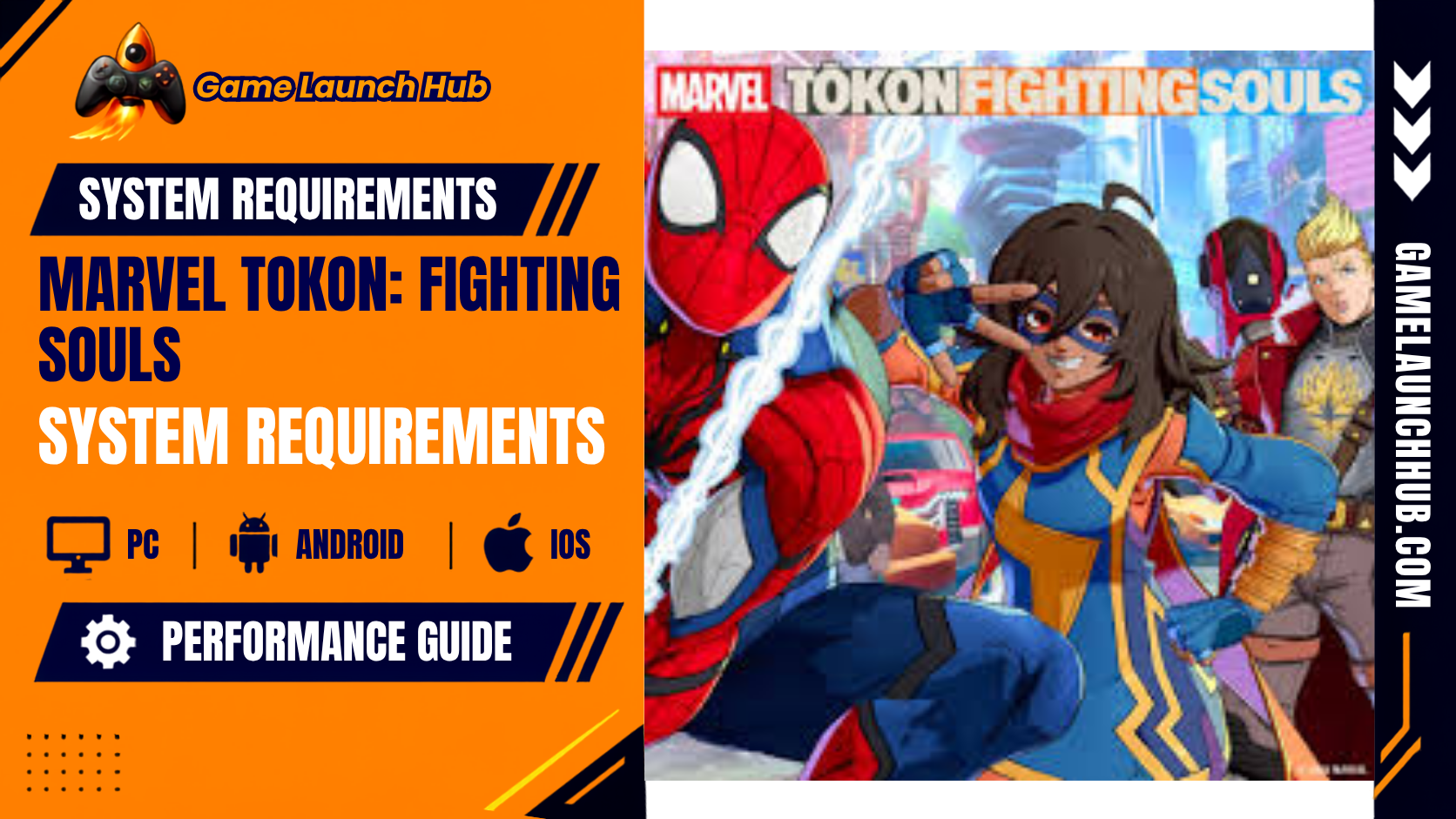

Marvel Tokon: Fighting Souls System Requirements: PC Specs, PS5 Performance & Steam Deck Status
Marvel Tokon: Fighting Souls is a 4v4 tag-team fighting game from Arc System Works, the studio behind Dragon Ball FighterZ and Guilty Gear Strive, published by Sony Interactive Entertainment in partnership with Marvel Games. It launched on 6 August 2026 for PC and PlayStation 5 only. Performance-wise, this is a mid-weight fighting game that targets a locked 60 fps across every platform it supports, but the PC version launched with significant optimisation problems that you need to know about before buying. The specifications below are taken from the official Marvel Tokon Steam page and the PlayStation PC specs page, cross-checked against ElAnalistaDeBits’ technical comparison and Eurogamer’s launch coverage.
System Requirements
Minimum (Windows, 1080p at 60 FPS, Low Preset)
| Component | Requirement |
|---|---|
| OS | Windows 11 (64-bit) |
| Processor | Intel Core i5-8400 or AMD Ryzen 5 1600X |
| Memory (RAM) | 16 GB |
| Graphics | NVIDIA GeForce RTX 2060 (6 GB) or AMD Radeon RX 6600 XT (8 GB) |
| VRAM | 6 GB on the NVIDIA card, 8 GB on the AMD card |
| DirectX | Not specified on the Steam page |
| Storage | 27 GB available space |
| Additional Notes | 64-bit processor and operating system required. Crossplay supported between PC and PS5. No SSD requirement stated. |
Source: Marvel Tokon Steam store page and PlayStation PC specs page. Last verified: 13 September 2026.
What this means in practice: The minimum tier targets 1080p at 60 fps on Low settings. The RTX 2060 is a 2019 mid-range card with 6 GB of VRAM, and the i5-8400 is a 2017 processor. This is a more demanding bar than most fighting games, which typically target a GTX 1060 at minimum. The 16 GB RAM requirement is non-negotiable and appears unchanged across both tiers. The 6 GB VRAM floor rules out the 3 GB and 4 GB variants of older mid-range cards, and it reflects the game’s detailed 2.5D character models and particle-heavy effects. The 27 GB install size is moderate. Note the Easy Anti-Cheat (EAC) incompatibility with Steam Deck and Linux, which is discussed in detail below, as this is the single most important practical consideration for PC buyers.
Recommended (Windows, 1440p at 60 FPS, High Preset)
| Component | Requirement |
|---|---|
| OS | Windows 11 (64-bit) |
| Processor | Intel Core i7-8700 or AMD Ryzen 5 3600X |
| Memory (RAM) | 16 GB |
| Graphics | NVIDIA GeForce RTX 3070 (8 GB) or AMD Radeon RX 7600 XT (16 GB) |
| VRAM | 8 GB on the NVIDIA card, 16 GB on the AMD card |
| DirectX | Not specified on the Steam page |
| Storage | 27 GB available space |
| Additional Notes | 64-bit processor and operating system required. Crossplay supported. No SSD requirement stated. |
Source: Marvel Tokon Steam store page and PlayStation PC specs page. Last verified: 13 September 2026.
What this means in practice: The recommended tier targets 1440p at 60 fps on High settings, and the RTX 3070 is a 2020 upper-mid-range card. The processor jumps from a 2017 i5 to a 2020 Ryzen 5 or 2017 i7, which reflects the game’s CPU load in 4v4 tag-team combat with up to eight characters on screen simultaneously. The 8 GB VRAM on the RTX 3070 is the practical target for 1440p rendering. The 16 GB on the RX 7600 XT is generous and reflects that card’s standard configuration rather than a specific demand of this game. If you have a gaming PC from the last four to five years with a mid-range GPU and 16 GB of RAM, you will meet this tier comfortably. However, see the performance note below before purchasing, as the recommended hardware alone did not guarantee a smooth experience at launch.
PC Launch Performance: What You Need to Know
The PC version of Marvel Tokon: Fighting Souls launched with widespread technical problems that affected players regardless of their hardware. According to Eurogamer’s launch report, players reported significant stuttering, dropped frames, and netcode issues including rollback spikes during online play. A player on Reddit quoted by GameSpot’s PC launch coverage stated: “You could be running a 5090 with a 9800X3D at the lowest settings and it’ll still happen,” which means the problem was not hardware-dependent. Arc System Works released a day-one patch and a subsequent update on 10 August 2026 that improved stability, and Polygon’s coverage confirmed that players could “finally beat each other up at 60 fps” after the patch. Destructoid’s report noted that Steam reviews improved from “Mostly Negative” to “Mixed” following the update. If you are buying the PC version now, check recent Steam reviews for the current state, as the game has been patched multiple times since launch.
PlayStation 5
| Component | Requirement |
|---|---|
| Firmware | Latest PS5 system software |
| Storage | Not specified on the PlayStation Store listing; PC version requires 27 GB |
| Performance | Locked 60 fps on both PS5 and PS5 Pro; 4K resolution on PS5 Pro with PSSR upscaling |
| Additional Notes | Console exclusive at launch; crossplay with PC supported; no Xbox or Switch 2 version |
Source: ElAnalistaDeBits’ technical comparison via Playground, Vandal’s technical analysis, and Gematsu’s official coverage. Last verified: 13 September 2026.
What this means in practice: The PS5 version is the definitive way to play Marvel Tokon: Fighting Souls at launch. ElAnalistaDeBits’ technical comparison confirmed that both the base PS5 and PS5 Pro run at a locked 60 fps in both offline and online modes, with no frame drops. The PS5 Pro benefits from PSSR upscaling for a sharper 4K image, but the base PS5 also delivers a stable and responsive experience. The frame rate lock applies across all platforms, including PC, which is standard for competitive fighting games where frame consistency directly affects gameplay. Vandal’s analysis described the PS5 version as “by far the most recommendable” way to play. If you own a PS5, this version avoids the performance issues that plagued the PC launch entirely.
Xbox Series X|S, Nintendo Switch 2, and PS4: Not Available
Marvel Tokon: Fighting Souls is a PlayStation console exclusive. There is no Xbox Series X|S version, no Nintendo Switch or Switch 2 version, and no PS4 version. Vandal’s platform inquiry confirmed there is “no official information” about a future Xbox or Switch 2 release, and the game’s official FAQ on tokon.gg states plainly that “Marvel Tokon Fighting Souls is not coming to Xbox. Not Xbox Series X, not Xbox Series S, not any Microsoft platform.” Our Culture Mag’s release coverage similarly described the game as a “PlayStation 5 console exclusive” that is “skipping Xbox Series X and S and Nintendo Switch 2.” If you play primarily on Xbox or Nintendo hardware, you cannot access this game.
Steam Deck and Linux: Not Supported
The PC version of Marvel Tokon: Fighting Souls cannot launch on Steam Deck or any Linux-based system due to an Easy Anti-Cheat (EAC) incompatibility. VGtimes’ open beta report first identified this issue, with players receiving an error stating that “no anti-cheat module was found for the platform.” Yahoo Tech’s launch coverage confirmed the problem persists in the retail release. While EAC is technically capable of running on Linux with a simple toggle from the developer, Arc System Works has not enabled this support, and a community manager reportedly stated on Discord that “asking for Linux support is like asking for a Switch port,” which was widely criticised given that Linux support for EAC requires only a configuration change. If you own a Steam Deck and want to play this game, you cannot, and there is no announced timeline for a fix.
macOS: Not Available
Marvel Tokon: Fighting Souls is a Windows-only release on PC. There is no macOS version available, and neither Arc System Works nor Sony has announced plans for one. Mac users can technically play the Windows version through CrossOver or similar compatibility tools, but the Easy Anti-Cheat layer makes this unlikely to work. If you are a Mac user, your only option is the PS5 version.
Final Verdict: Can Your Setup Run Marvel Tokon: Fighting Souls?
Marvel Tokon: Fighting Souls is a game where the platform you choose matters more than your PC specifications. On PS5, the game runs at a locked 60 fps with no frame drops, and the PS5 Pro adds PSSR upscaling for a sharper 4K image. If you own a PS5, that is the version to buy, full stop.
On PC, the situation is more complicated. The minimum specs ask for an RTX 2060 and 16 GB of RAM, which is hardware from 2019. The recommended tier asks for an RTX 3070, which is a 2020 upper-mid-range card. If you have a gaming PC from the last four to five years with a mid-range GPU and 16 GB of RAM, you meet the recommended tier. However, the PC version launched with severe optimisation problems that affected players regardless of their hardware, including stuttering, frame drops, and netcode issues. Post-launch patches have improved the experience significantly, and Polygon’s coverage confirms the game now runs at 60 fps for many players, but the launch state was poor enough that you should check current reviews before buying.
The Steam Deck and Linux incompatibility is a hard block. If you play on Steam Deck, you cannot run this game, and there is no fix on the horizon. The game also requires 16 GB of system RAM at both minimum and recommended tiers, so if you are still running 8 GB, you will need to upgrade before playing. VRAM is less of a concern: 6 GB is the floor at 1080p, and 8 GB covers 1440p comfortably.
If you own a PS5, buy it there. If you are PC-only, check the current patch status and make sure your system has 16 GB of RAM and a GPU with at least 6 GB of VRAM before committing.
Specs may be revised by Arc System Works in future patches, and the developer has already released multiple performance updates since launch. This article reflects the Steam store page, PlayStation PC specs page, ElAnalistaDeBits’ technical comparison, Eurogamer, Polygon, GameSpot, Destructoid, Vandal, and verified outlet reports as of 13 September 2026. Chen Xi verifies all specifications by checking official store pages and dating each table; no numbers in this article are estimated or inferred.