


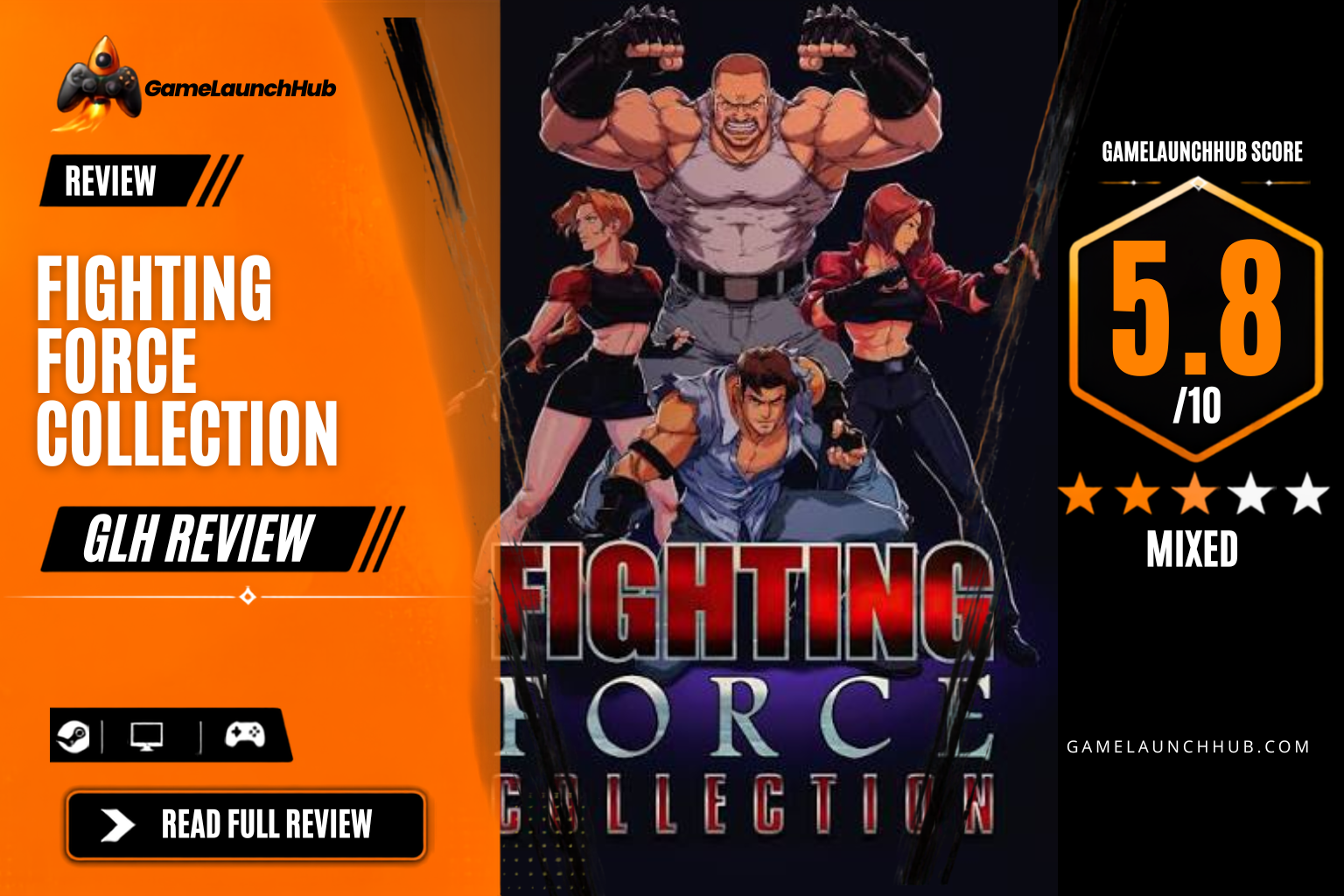

Fighting Force Collection: Is It Worth It? Our Honest Verdict
Introduction
The late 1990s were a strange and wonderful time for video games. It was an era of experimentation, when developers were still figuring out what 3D gaming could be. Not every experiment succeeded. Some games were brilliant. Others were noble failures. And some were simply… there. The Fighting Force series falls into a category all its own: a pair of games that were never critical darlings, never commercial blockbusters, but somehow carved out a small, devoted following.
Now, nearly three decades later, Fighting Force Collection brings these two PlayStation 1 classics back to modern platforms. Developed by Implicit Conversions and published by Limited Run Games, this collection launched on January 23, 2026, for PC, PlayStation 4, PlayStation 5, and Nintendo Switch. It includes Fighting Force (1997) and Fighting Force 2 (1999), two 3D beat ’em ups that have aged about as gracefully as milk left out in the sun. But here is the thing: nostalgia is a powerful drug. And for those who remember renting these games from Blockbuster, there is something undeniably appealing about revisiting them. We have spent hours punching, kicking, and awkwardly navigating through these relics of a bygone era. So, after all that, we have to ask: is Fighting Force Collection worth your time and credits? Let’s break it down.
Quick Verdict Box
TL;DR: Fighting Force Collection is a bare-bones remaster of two deeply flawed 1990s beat ’em ups that have not aged gracefully. The first game retains some nostalgic charm and chaotic co-op fun, but the second is a confusing, poorly executed shift to stealth action. The collection offers modern features like save states and rewind, but the core gameplay is clunky, repetitive, and uninspired. This is a collection for die-hard nostalgics and retro historians only.
Buy it if:
- You have fond memories of playing Fighting Force on the original PlayStation
- You are a retro gaming historian interested in a failed Streets of Rage 4 prototype
- You want a cheap, mindless co-op beat ’em up to play with a friend for an afternoon
Skip it if:
- You expect polished, modern gameplay with responsive controls
- You have no nostalgia for these games (they will likely frustrate you)
- You are looking for a well-crafted, content-rich collection
What Is Fighting Force Collection?
| Detail | Information |
|---|---|
| Developer | Implicit Conversions (Core Design) |
| Publisher | Limited Run Games |
| Genre | 3D Beat ‘Em Up / Action |
| Platforms | PC (Steam), PS4, PS5, Nintendo Switch |
| Price | $19.99 / €19.99 / £15.99 |
| Release Date | January 23, 2026 |
Fighting Force Collection is a compilation of two PlayStation 1 classics from the late 1990s. The first game, Fighting Force (1997), is a 3D beat ’em up where players choose from four characters, Hawk Manson, Mace Daniels, Alana McKendricks, or Ben “Smasher” Johnson, and fight through seven levels across 22 stages to take down the evil Dr. Dex Zeng. The sequel, Fighting Force 2 (1999), abandons the beat ’em up formula for a more stealth-action approach, following Hawk Manson as he investigates human cloning experiments. The collection includes modern features such as save states, rewind, uprendering, CRT filters, bonus content, and a game selector. The official announcement from Limited Run Games and Implicit Conversions provides more details on the release.
Gameplay & Mechanics
Fighting Force (1997): Chaotic, Clunky, but Fun
The original Fighting Force is the stronger of the two games, and even then, it is far from a classic. It is a straightforward 3D beat ’em up that plays like a less polished, less refined version of Sega’s Die Hard Arcade. You choose one of four characters, each with different stats and fighting styles, and you punch, kick, and weapon-smash your way through hordes of enemies.
The combat has a certain weight to it, and there is a genuine satisfaction in picking up a rocket launcher or shotgun and watching enemies fly across the screen. The game features dozens of moves per character, destructible environments, and that distinctly late-1990s sense that excess was a feature rather than a flaw. But the controls are clunky, the camera is awkward, and the combat lacks the fluidity and depth of its 2D predecessors. As one Metacritic review noted, “The first game is more appealing and easier to pick up, as its beat ’em up premise, despite being simple, works well, especially when played with a friend.”
The game is at its best in co-op mode, where the chaos is amplified and the clunky controls become part of the fun. But even then, it is a shallow, repetitive experience that wears out its welcome long before the credits roll. As OpenCritic puts it, “Fighting Force Collection is less than the sum of its parts.”
Fighting Force 2 (1999): A Failed Reinvention
If the first game is a mediocre beat ’em up, the sequel is a confusing mess. Fighting Force 2 abandons the beat ’em up formula entirely, attempting to reinvent the franchise as a stealth-action game inspired by Metal Gear Solid and Syphon Filter. You play as Hawk Manson, now recast as a military-grade mercenary, sneaking through R&D facilities and engaging in hand-to-hand combat with over 20 weapons at your disposal.
The problem is that the game is terrible at everything it attempts. The stealth mechanics are clunky and frustrating. The combat is stiff and unrewarding. The camera is abysmal. And the character of Hawk Manson, once a fun street brawler, is now a painfully generic action hero. As one Metacritic review put it, “Fighting Force 2 is still awful, in every way.” Another noted that “the second game, however, should have remained forgotten.” It is a failed reinvention of a doomed IP, and it has aged even more poorly than the first game.
Modern Features: A Bare Minimum Effort
The collection includes modern features like save states, rewind, uprendering, CRT filters, and a game selector. These are welcome additions, but they are essentially the bare minimum for a retro compilation in 2026. The presentation is lackluster, with a menu layout that feels like an open-source emulator. The included gallery of concept art is disappointing, especially considering the fascinating development history of the original Fighting Force, which began life as a SEGA Saturn exclusive and a potential Streets of Rage 4 prototype.
Story & Presentation
Narrative: Barely There
The story is not why you are here. In the first game, you are fighting to take down the evil Dr. Dex Zeng. In the second, you are investigating human cloning experiments. That is about as deep as it gets. The narrative is a thin excuse for the punching, and it does not pretend to be anything more.
Visuals: Preserved, Not Improved
The visuals are presented in their original form, with uprendering and CRT filters available to smooth out the rough edges. The games look like PlayStation 1 games from the late 1990s: blocky, low-poly, and full of charm for those who grew up with them. For everyone else, they will look dated and ugly. As one Metacritic review noted, the collection “preserves a messy, excessive era of PlayStation history, where fun mattered more than polish.” But that is also the problem: there is little effort to improve or enhance the experience beyond basic preservation.
Audio: A Blast from the Past
The audio is similarly preserved. The soundtracks are classic late-1990s fare: energetic, cheesy, and full of that distinct PlayStation 1 MIDI quality. The sound effects are punchy and satisfying, at least in the first game. In the second, the audio is functional but forgettable.
Performance & Technical
The collection runs well on all platforms. Both games are playable, with no game-breaking issues or lazy emulation shortcuts. The file size is modest at 961 MB on Nintendo Switch, with 4 GB of storage required on PC. The system requirements are low, making it accessible to almost any modern PC.
However, the emulation is not flawless. Some reviews have noted “weak emulation” and “poor presentation.” The collection is functional, but it lacks the polish and attention to detail that fans have come to expect from retro compilations. As OpenCritic notes, “Not enough has been done to bring in a new crowd.”
Pros and Cons
Pros
Cons
How It Compares
| Game | Price | Key Features | Quality |
|---|---|---|---|
| Fighting Force Collection | $19.99 | Two 3D beat ’em ups; save states; rewind | Low |
| Streets of Rage 4 | $24.99 | Modern 2D beat ’em up, deep combat, and online co-op | High |
| Teenage Mutant Ninja Turtles: Shredder’s Revenge | $24.99 | 2D beat ’em up; 6-player co-op; modern design | High |
Fighting Force Collection is a relic of a bygone era. Compared to modern beat ’em-ups like Streets of Rage 4 or TMNT: Shredder’s Revenge, it feels ancient, clunky, and deeply unsatisfying. Those games offer fluid combat, responsive controls, and deep mechanics. Fighting Force Collection offers clunky tank controls and awkward combat. It is a game for historians and nostalgics, not for players looking for a quality gaming experience. The OpenCritic ranking in the 10th percentile reflects this.
Who Should Buy This?
For nostalgic PlayStation 1 owners: If you rented Fighting Force from Blockbuster and have fond memories of it, this collection is a cheap way to revisit those memories.
For retro gaming historians: The original Fighting Force began life as a potential Streets of Rage 4 prototype for the SEGA Saturn. That history alone makes it a fascinating curiosity for genre enthusiasts.
For players looking for a cheap, mindless co-op experience: The first game is chaotic fun with a friend, even if it is deeply flawed.
For anyone looking for polished, modern gameplay: Skip it. The combat is clunky, the controls are awkward, and the games have not aged well.
For players who have no nostalgia for these games: Avoid it. There is nothing here for you.
THE GLH RATING
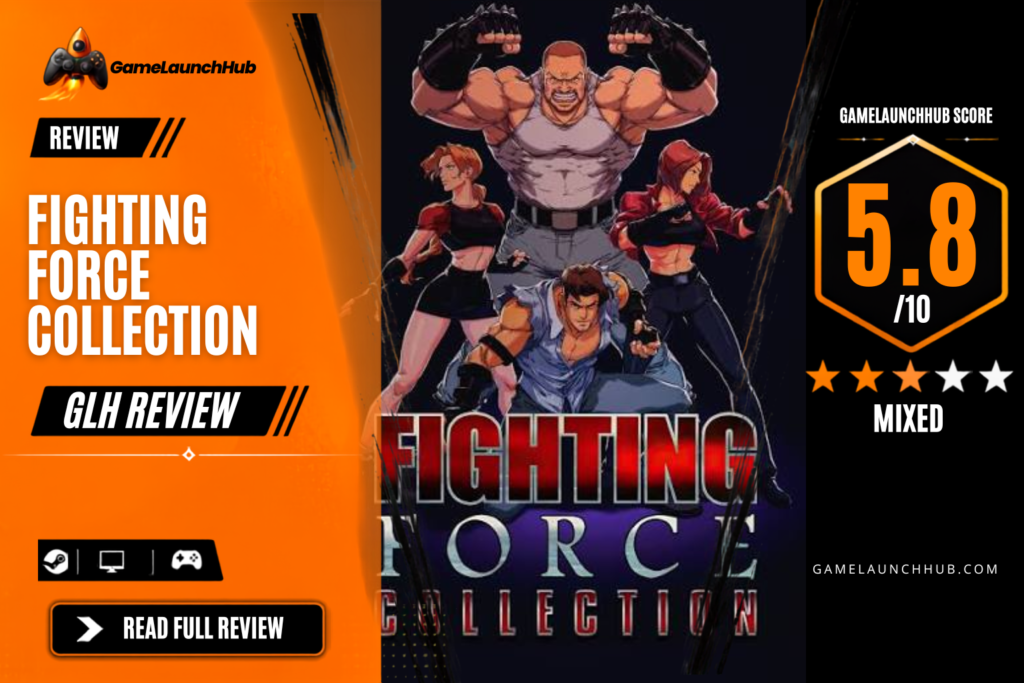
Our Take: After hours of punching, kicking, and awkwardly navigating through these 1990s relics, we came away with a clear verdict. Fighting Force Collection is a bare-bones remaster of two deeply flawed games that have not aged gracefully. The first game retains some nostalgic charm and chaotic co-op fun, but the second is a confusing, poorly executed shift to stealth action that should have been left in the past. The collection offers modern features like save states and rewind, but the core gameplay is clunky, repetitive, and uninspired. This is a collection for die-hard nostalgics and retro historians only. For everyone else, it is a hard pass.
Overall Score: 5.8 / 10
★★★☆☆
Verdict: MIXED
| Category | Score |
|---|---|
| Gameplay | 5.0 / 10 |
| Story & Presentation | 5.0 / 10 |
| Performance & Polish | 6.5 / 10 |
| Value for Money | 6.0 / 10 |
| Replayability | 4.0 / 10 |
FAQ
Is Fighting Force Collection worth buying?
Only if you have strong nostalgia for the original games or are a retro gaming historian. The collection has a 63 Metascore on PS5 and a 65 Metascore on Switch, reflecting its mixed critical reception. At $19.99, it is cheap, but the games themselves are deeply flawed and have not aged well.
Is Fighting Force Collection worth it on Switch?
The Switch version runs well and includes all the modern features. However, the core gameplay issues remain. If you are going to buy it, the Switch version is as good as any.
How long to beat Fighting Force Collection?
Each game takes around 2-3 hours to complete. The entire collection can be finished in 4-6 hours, depending on your skill level and tolerance for frustration.
Is the Fighting Force Collection worth the full price?
At $19.99, the collection is cheap enough that it is hard to feel ripped off. However, for players without nostalgia for these games, the value proposition is weak. Consider waiting for a sale.
What is the best game in Fighting Force Collection?
The original Fighting Force is the stronger and more cohesive title. It is a clunky but fun 3D beat ’em up. Fighting Force 2 is a failed reinvention that should be avoided.
Is Fighting Force Collection a good game?
No. The games are not good by modern standards, and they were not particularly good by 1990s standards either. They are historical curiosities at best.
Does Fighting Force Collection have online multiplayer?
No. The collection does not include online multiplayer for either game. However, the Steam version includes Remote Play Together support.
Conclusion
Fighting Force Collection is a game that exists primarily to satisfy nostalgia and historical curiosity. It is not a good game by modern standards, and it was not a particularly good game by 1990s standards either. The first game is a clunky but occasionally fun 3D beat ’em up that is best enjoyed in co-op mode. The second is a failed reinvention that should have been left in the past. The collection offers modern features like save states and rewind, but the core gameplay is repetitive, clunky, and uninspired.
For those who have fond memories of renting Fighting Force from Blockbuster, this collection is a cheap way to revisit those memories. For retro gaming historians, the game’s fascinating development history as a potential Streets of Rage 4 prototype makes it worth a look. For everyone else, it is a hard pass.
Final recommendation: Buy it only if you have strong nostalgia for these games or are a retro gaming historian. Otherwise, skip it.
Read Also: Avowed Review: Obsidian’s Skyrim-Style RPG