



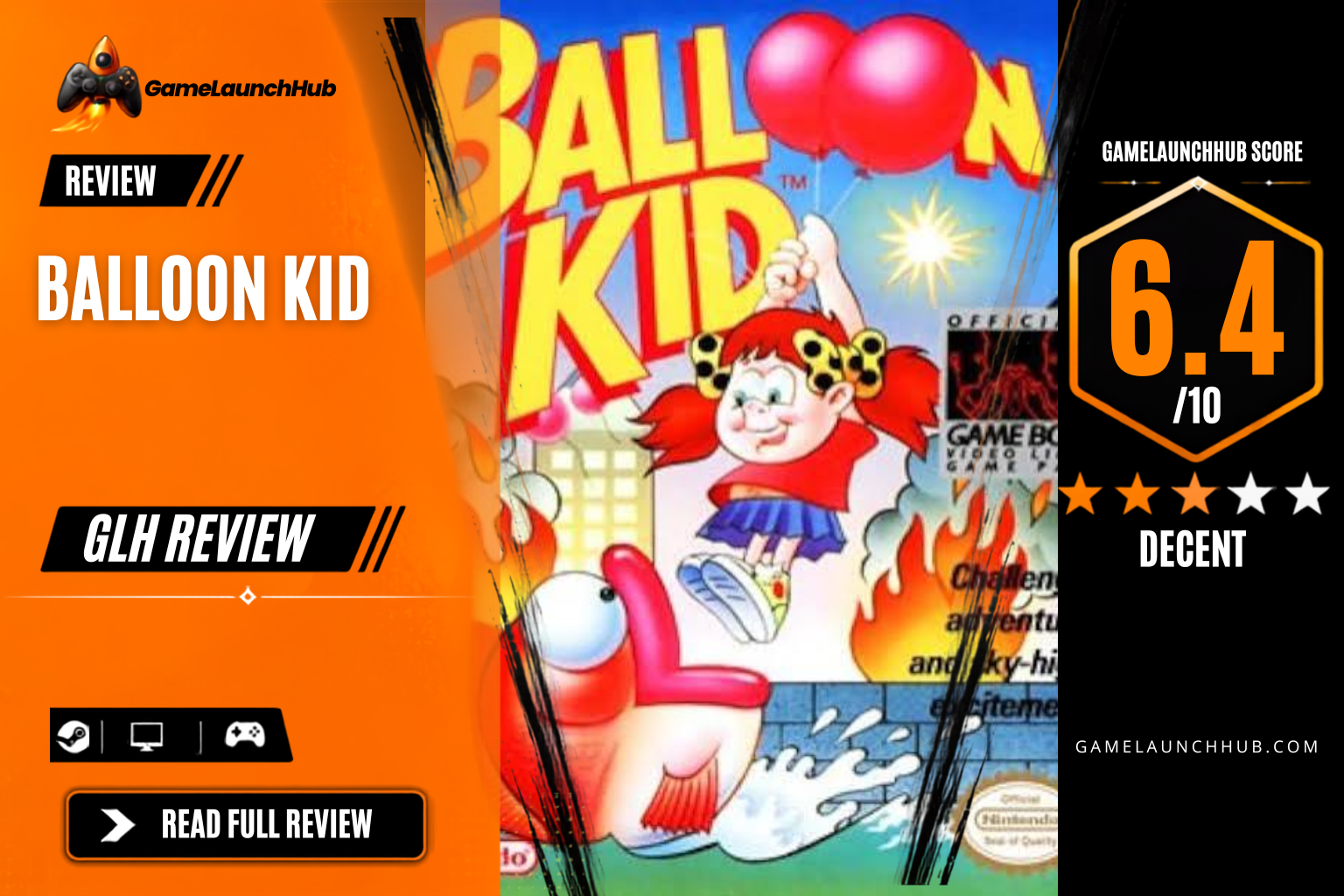

Balloon Kid: Is It Worth It? Our Honest Verdict
Introduction
Some games are remembered for their ambition. Others for their polish. And then there are games like Balloon Kid, a title that is remembered, if at all, for being a strange, charming, and unexpectedly difficult oddity from Nintendo’s early Game Boy days. It is the sequel nobody asked for to the NES cult classic Balloon Fight, a game that took the simple, addictive “Balloon Trip” mode and stretched it into a full-fledged, eight-level side-scrolling adventure.
Originally released in October 1990, Balloon Kid arrived at a time when Nintendo was still figuring out what the Game Boy could be. It was developed under the supervision of Gunpei Yokoi, the legendary designer behind the Game Boy itself and the creator of the Metroid series. And yet, for decades, it remained a forgotten footnote in Nintendo’s history, a game that was pleasant enough but never quite essential.
That changed in February 2026, when Balloon Kid was added to the Nintendo Switch Online Game Boy library. Suddenly, a new generation of players could experience this quirky little sequel. And so, we have to ask: is Balloon Kid worth your time? Is this a hidden gem that deserves to be unearthed or a relic best left in the past? We have spent hours floating, falling, and frantically flapping our way through its eight stages. Let’s break it down.
Quick Verdict Box
TL;DR: Balloon Kid is a charming but deeply flawed Game Boy platformer that takes the core of Balloon Fight and stretches it into a full adventure. Its music and visuals are delightful, and the core balloon-floating mechanic is genuinely unique. But slippery controls, repetitive level design, and a brutal difficulty spike in the later stages make it a frustrating experience that is more interesting as a historical curiosity than as a game you will want to play for hours.
Buy it if:
- You are a retro gaming enthusiast curious about Nintendo’s early Game Boy library
- You enjoyed Balloon Fight and want to see its sequel
- You have a Nintendo Switch Online subscription and want to try it at no extra cost
Skip it if:
- You have a low tolerance for slippery controls and frustrating difficulty
- You prefer games with tight, responsive platforming
- You are looking for a deep or lengthy adventure (it can be beaten in about an hour)
What Is Balloon Kid?
| Detail | Information |
|---|---|
| Developer | Nintendo R&D1 |
| Publisher | Nintendo |
| Genre | 2D Side-Scrolling Platformer |
| Platforms | Game Boy, Nintendo Switch Online (Game Boy) |
| Price | Included with Nintendo Switch Online subscription ($20/year or $3.99/month) |
| Release Date | October 1990 (Game Boy); February 2026 (Switch Online) |
Balloon Kid is a 2D side-scrolling platformer developed by Nintendo for the original Game Boy. It is a sequel to the 1985 NES game Balloon Fight, expanding on that game’s “Balloon Trip” mode into a full adventure with eight stages, a story, and boss encounters. You play as Alice, a young girl who must rescue her brother Jim after he is swept away by a gust of wind while holding too many balloons. The game was added to the Nintendo Switch Online Game Boy library in February 2026.
Gameplay & Mechanics
The Core Loop: Float, Fall, and Flap
The heart of Balloon Kid is its unique balloon-floating mechanic. Alice is tethered to two balloons that keep her aloft. To ascend, you repeatedly tap the A button to “flap” her arms, gaining altitude. To descend, you simply stop flapping. This creates a constant, almost rhythmic tension, you are never truly at rest, always making micro-adjustments to your height to avoid hazards.
As one reviewer put it, “the precise movement this part requires” is the core of the challenge. The game scrolls automatically from right to left, forcing you to keep moving forward. You collect balloons along the way for points and extra lives, and you must navigate through tight corridors, spike traps, and enemies that are desperate to pop your balloons.
The Ground Game: A Clunky Alternative
You can also release your balloons at any time by pressing the Down button, allowing Alice to fall to the ground. On foot, she can walk, jump, and stomp on enemies from above. This is essential for fitting through tight spaces and for defeating bosses, which often require you to drop down onto their heads.
However, the ground controls are notoriously slippery and unpolished. As one reviewer noted, “The on-foot controls are very slippery and strangely unpolished for a Nintendo-published title.” This clunkiness is a recurring frustration, especially in the later stages where precision is paramount.
Difficulty: A Cute Exterior Hiding a Brutal Core
Balloon Kid is a game of two halves. The first few stages are charming and relatively forgiving, with whimsical music and simple hazards. But as you progress, the difficulty ramps up sharply. The later stages are “extremely challenging,” with tighter corridors, more aggressive enemies, and more complex level designs that demand near-perfect execution.
The game’s auto-scrolling nature means you cannot take your time. The screen constantly pushes you forward, and there are no safe areas to catch your breath. As one critic put it, “This is just a game in which you can absolutely never relax and rest.” This combination of floaty controls and relentless difficulty can be a recipe for frustration.
Story & Presentation
Narrative: Simple and Sweet
The story is charming in its simplicity. Alice and her younger brother Jim live in the town of Pencilvania and love playing with balloons. One day, Jim ties too many balloons to himself and is carried away by the wind. Alice sets off on a rescue mission, following Jim’s balloon trail through eight stages.
It is a cute premise, but it is also paper-thin. As one reviewer noted, “The story isn’t really detailed at all.” The game does not feature any dialogue or cutscenes; the story is simply the framing device for the gameplay. Still, it is a nice touch that gives the game more personality than a simple score-chaser.
Visuals: Classic Game Boy Charm
For an early Game Boy title, Balloon Kid looks quite good. The sprites are detailed and expressive, and the backgrounds feature charming touches like giant pencils and mountains. The game makes effective use of the monochrome palette, with clear visual distinction between foreground and background elements.
Audio: The Game’s Undeniable Highlight
If there is one thing that nearly everyone agrees on, it is that Balloon Kid has a fantastic soundtrack. The music is “highly memorable” and “incredible.” The after-boss tunes, in particular, have been singled out as “amazing” and “sentimental.”
The sound design is also effective, with satisfying audio cues for collecting balloons, stomping enemies, and losing a life. The music is arguably the game’s strongest asset, and it is the primary reason many players keep coming back despite the frustrating gameplay.
Performance & Technical
As a Game Boy game from 1990, Balloon Kid runs smoothly on original hardware and on emulators. The Nintendo Switch Online version includes all the standard features of the service: save states, rewind functionality, and the ability to play in handheld or docked mode.
One technical issue that has been noted is the frame rate. Compared to the original Balloon Fight, Balloon Kid can feel sluggish, with some players describing the frame rate as “sooo much worse than balloon fight.” This is likely a limitation of the Game Boy hardware, but it does affect the responsiveness of the controls.
Pros and Cons
Pros
Cons
| ❌ | Slippery, unresponsive controls that make precision platforming frustrating |
| ❌ | Repetitive level design that doesn’t evolve much over eight stages |
| ❌ | Brutal difficulty spike in the later stages |
| ❌ | Short runtime (can be beaten in about an hour) |
| ❌ | Lack of variety, the core mechanic never really changes. |
How It Compares
| Game | Price | Key Feature | Difficulty |
|---|---|---|---|
| Balloon Kid | NSO | Balloon-floating platformer; unique mechanics | High |
| Balloon Fight | NSO | Arcade-style balloon popping; competitive multiplayer | Moderate |
| Kirby’s Dream Land | NSO | Traditional platformer; accessible difficulty | Low |
Balloon Kid is a direct sequel to Balloon Fight, but it is a very different game. Where Balloon Fight is an arcade-style score-chaser, Balloon Kid is a linear adventure. Compared to Kirby’s Dream Land, another early Game Boy platformer, Balloon Kid is significantly more difficult and less polished. It is a game for those who appreciate Nintendo’s experimental side, but it lacks the timeless appeal of the company’s best work.
Who Should Buy This?
For retro gaming enthusiasts: If you are curious about Nintendo’s early Game Boy library and want to experience a forgotten oddity, Balloon Kid is worth a look. It is a fascinating piece of Nintendo history.
For fans of Balloon Fight: If you enjoyed the original Balloon Fight and want to see how its mechanics were expanded into a full adventure, you will find plenty to appreciate.
For Nintendo Switch Online subscribers: Since the game is included with the subscription at no extra cost, there is little downside to trying it out. Even if you only play it for an hour, it is a neat piece of gaming history.
For players looking for tight, polished platforming, the slippery controls and frustrating difficulty make this a tough sell. If you value precision and responsiveness, you will likely be frustrated.
For players seeking a deep or lengthy experience: The game can be beaten in about an hour, and there is little reason to replay it once you have finished.
THE GLH RATING
Our Take: After spending time floating, falling, and flapping our way through Balloon Kid, we came away with a complicated relationship with this little Game Boy oddity. The balloon-floating mechanic is genuinely unique and often quite fun, the music is fantastic, and the game has a charming, whimsical personality. But the slippery controls, repetitive level design, and brutal difficulty spike in the later stages make it a frustrating experience that is more interesting as a historical curiosity than as a game you will want to play for hours. It is a game that is easy to admire but hard to love.
Overall Score: 6.4 / 10
★★★☆☆
Verdict: DECENT
| Category | Score |
|---|---|
| Gameplay | 5.5 / 10 |
| Story & Presentation | 7.0 / 10 |
| Performance & Polish | 6.5 / 10 |
| Value for Money | 7.5 / 10 |
| Replayability | 4.0 / 10 |
FAQ
Is Balloon Kid worth buying?
It depends on what you are looking for. If you are a retro gaming enthusiast or a Nintendo Switch Online subscriber, it is worth trying out. The game has a 64% average review score from critics, reflecting its mixed reception. It is a charming but deeply flawed game that is more interesting as a historical curiosity than as a must-play classic.
Is Balloon Kid worth it on Nintendo Switch Online?
Yes, if you already have a subscription. The game is included at no extra cost, so there is little downside to trying it out. However, if you are considering subscribing just for this game, you may be disappointed.
How long to beat Balloon Kid?
The main story takes about 1 hour to complete. If you are a completionist looking to master the game, you can expect to spend 2-3 hours.
Is Balloon Kid a difficult game?
Yes. The early stages are relatively forgiving, but the later stages are “extremely challenging.” The combination of floaty controls and relentless auto-scrolling makes it a frustrating experience for many players.
Is Balloon Kid a sequel to Balloon Fight?
Yes. It is a direct sequel to the 1985 NES game Balloon Fight, expanding on that game’s “Balloon Trip” mode into a full adventure with eight stages and a story.
Does Balloon Kid have multiplayer?
Yes, the original Game Boy cartridge featured a two-player mode that allowed for simultaneous play of the story stages. However, this mode is not available in the Nintendo Switch Online version.
Who developed Balloon Kid?
Balloon Kid was developed by Nintendo, under the supervision of Gunpei Yokoi, the legendary designer behind the Game Boy and the Metroid series. The game was directed by Yoshio Sakamoto.
Conclusion
Balloon Kid is a game that is easy to admire but hard to love. It is a fascinating piece of Nintendo history, a quirky sequel to a cult classic that attempted to turn a simple arcade mode into a full-fledged adventure. Its balloon-floating mechanic is genuinely unique, its music is fantastic, and its visuals are charming. But slippery controls, repetitive level design, and a brutal difficulty spike in the later stages make it a frustrating experience that is more interesting as a historical curiosity than as a game you will want to play for hours.
For retro gaming enthusiasts and Nintendo Switch Online subscribers, it is worth a look. But for everyone else, it is a game that is best left to the history books.
Final recommendation: Try it if you have Nintendo Switch Online. Otherwise, it is not worth seeking out.