





Introduction
There are games that make you feel powerful, games that make you feel smart, and then there are games that make you feel like a T-shaped teenager trying to eat breakfast with both arms permanently stuck out to the sides. to a T is firmly in the third category. And somehow, against all odds, it works.
Developed by uvula, a small studio co-founded by Katamari Damacy creator Keita Takahashi, and published by Annapurna Interactive, to a T is a narrative adventure that asks a simple question: what happens when you take a completely ordinary life and make it completely extraordinary by giving the protagonist a body that refuses to cooperate? You play as Teen, a 13-year-old whose arms are permanently stuck in a T-pose, navigating a small seaside town, dealing with bullies, making friends, and trying to figure out where the sun went. It’s weird, it’s heartfelt, and it’s one of the most memorable games of 2025.
We’ve spent about five hours living Teen’s T-shaped life, brushing teeth with special toothbrushes, pouring cereal with outstretched arms, and flying through the air by spinning like a human helicopter. So, after all that, we have to ask: is to a T worth your time? Let’s break it down.
Quick Verdict Box
TL;DR: to a T is a wonderfully weird, heartfelt narrative adventure from the creator of Katamari Damacy. Its charming visuals, catchy songs, and sincere message about embracing difference make it a memorable experience. However, repetitive gameplay, control issues, and a story that goes off the rails in its second half hold it back from being a true classic. It’s “a remarkable, life-affirming wonder”, but one that doesn’t fully stick the landing.
Buy it if:
- You’re a fan of Keita Takahashi’s unique, whimsical game design
- You enjoy narrative-driven experiences with quirky characters and catchy songs
- You appreciate games that explore themes of difference and acceptance
Skip it if:
- Repetitive gameplay and simple minigames frustrate you
- You prefer deep, mechanically complex games over narrative experiences
- You’re looking for polished accessibility features (they’re lacking here)
What Is to a T?
| Detail | Information |
|---|---|
| Developer | uvula |
| Publisher | Annapurna Interactive |
| Genre | Narrative Adventure |
| Platforms | PC (Steam), PS5, Xbox Series X|S, Nintendo Switch 2 |
| Price | $19.99 / £16.99 / €19.99 |
| Release Date | May 28, 2025 (PC, PS5, Xbox); June 11, 2026 (Switch 2) |
to a T is a 3D narrative adventure game developed by Keita Takahashi and the uvula team. You play as Teen, a 13-year-old whose body is permanently stuck in a T-pose, and navigate their daily life in a small seaside town. The game is split into eight episodic chapters, each featuring original songs and a mix of exploration and minigames. It’s available on Steam, PS5, Xbox Series X/S, and Nintendo Switch 2.
Gameplay & Mechanics
The Core Loop: Daily Life, T-shaped
The gameplay of to a T is mostly simulation, as you go through Teen’s day-to-day life. You wake up, brush your teeth, eat breakfast, head to school, and explore the town. But every action is filtered through Teen’s unique condition. To brush your teeth, you need to carefully maneuver your outstretched arms to reach the toothbrush. To eat cereal, you pour the milk and cereal with individual arm controls. It’s awkward, it’s slow, and it’s surprisingly charming.
The game is divided into eight episodic chapters, each around 30 minutes long, with intro and outro sequences complete with original songs. Between chapters, you have free time to explore the town, collect coins, buy outfits, and interact with the colorful residents. As one review put it, to a T is “much more than its premise suggests”, it’s a game about finding joy in the everyday, no matter how strange.
Minigames: A Mixed Bag
Throughout the game, you’ll encounter a variety of minigames: rhythm games, maths problems, mazes, and more. Some are highlights, the rhythm games are particularly fun, with catchy tunes that you’ll find yourself humming long after you’ve put down the controller. Others feel more like filler. The maths problems, for example, throw numbers at you “full throttle, all over the screen,” which can be overwhelming rather than fun.
The minigames are intended to replicate the experience of navigating the world with a disability, but the execution is inconsistent. Some minigames cleverly use Teen’s T-shape, like angling your way through doors or avoiding knocking into people at school. Others feel disconnected from the core concept.
Exploration: A Charming but Repetitive World
TThe town of to a T is a joy to explore, at least at first. The colorful visuals, quirky characters, and whimsical music create a world that feels alive and welcoming. You can ride a unicycle, do big jumps, collect coins, and buy new outfits to customize the teen’s look.
But the novelty wears off. As one reviewer noted, “Most of the game has you running back and forth around town, which can feel pleasant thanks to the music and eclectic visuals but isn’t especially fun by itself.” The exploration is shallow, and the rewards are minimal. By the third or fourth chapter, the town starts to feel small rather than intimate.
Story & Presentation
Narrative: Heartfelt, Then Baffling
The story of To a T is where the game truly shines, at least for the first half. You play as Teen, a 13-year-old navigating the challenges of being different in a world that doesn’t quite know what to do with them. Bullies mock them, teachers struggle to accommodate them, and even simple tasks become Herculean efforts.
The game is clearly intended as a metaphor for disability, touching on everyday difficulties many take for granted. It’s a theme handled with surprising warmth and sincerity. As one critic put it, “To a T” is about asking serious questions in a silly voice. What does it mean to be perfect? What does perfect even mean?”
And then the second half happens. The story “spirals wildly from weird to downright absurd.” A mysterious object falls from the sky. A unicycle starts talking. A giraffe makes sandwiches. The game goes from grounded and relatable to cosmic and confusing. The “twist is odd, narratively speaking, and it also does a disservice to what could be a tidy theme about acceptance”.
Visuals: Peanuts Meets Takahashi
Visually, To a T is unmistakably a Keita Takahashi game. The art style is cute and colorful, with a 3D Peanuts-esque design that feels both nostalgic and fresh. The characters are charming, the town is vibrant, and the world feels like it was pulled from a children’s cartoon.
The fixed camera perspectives give the game a cinematic feel, though they can also be frustrating. “Camera movement is tied to your character; it changes angle as you move, so that ‘right’ turns into ‘up’ or ‘up’ becomes ‘down.’” This makes navigation unnecessarily confusing at times.
Audio: Earworms for Days
The music in tune is a standout feature. Each chapter has its own original song, complete with karaoke-style animation and lyrics that are “hilariously silly.” Tracks like “Y I B T shape, not U or F or O?” will get stuck in your head for days. The soundtrack is “filled with so much heart and evokes the sort of cartoons you’d see on Nick Jr. or Disney Junior.”
Performance & Technical
Performance is a mixed bag across platforms. On PS5 and Xbox Series X/S, the game runs reasonably well, though we encountered occasional stuttering and camera issues. The PC version is similarly serviceable, with modest system requirements.
The Switch 2 version, however, has some issues. The game is “a bit jittery when you fly or walk through small spaces.” Load times are longer, and the overall experience feels less polished than on other platforms.
Accessibility is a notable weak point. Despite the game’s theme of disability, there’s only one accessibility setting: instead of rotating your right joystick to spin and fly, you can press ‘R.’. As one critic noted, “It isn’t easily playable for the very audience it supposedly spotlights.”
Pros and Cons
Pros
Cons
How It Compares
| Game | Price | Playtime | Key Difference |
|---|---|---|---|
| to a T | $19.99 | 4-5 hours | Narrative adventure with disability metaphor and catchy songs |
| Katamari Damacy Reroll | $29.99 | 5-8 hours | Takahashi’s classic pure gameplay focus with rolling mechanics |
| A Short Hike | $7.99 | 2-3 hours | Cozy exploration game with heartfelt story and tight controls |
to a T is very much a Keita Takahashi game, but it’s not Katamari. Where Katamari was all about feel and gameplay, To a T is all about story and message. Compared to A Short Hike, it’s more narratively ambitious but less mechanically polished. At $19.99, it sits in a comfortable middle ground, more expensive than A Short Hike and cheaper than Katamari.
Who Should Buy This?
For fans of Keita Takahashi: If you loved Katamari Damacy or Noby Noby Boy, you’ll find plenty to appreciate here. The whimsy, the weirdness, and the heart are all present.
For players seeking a short, narrative-driven experience: At 4-5 hours, To a T is a perfect afternoon game. It doesn’t overstay its welcome, and it delivers a complete, emotionally resonant story.
For families and younger players: The game is kid-friendly, with a cartoonish art style and a positive message about acceptance. However, some minigames, like the fast-paced math problems, may require adult help.
For players who value polished gameplay: The repetitive exploration and frustrating camera controls may test your patience. If you prefer tight, responsive mechanics, this may not be the game for you.
For players seeking deep accessibility options: Despite its theme, To a T has minimal accessibility features. If you need robust options, you may be disappointed.
THE GLH RATING
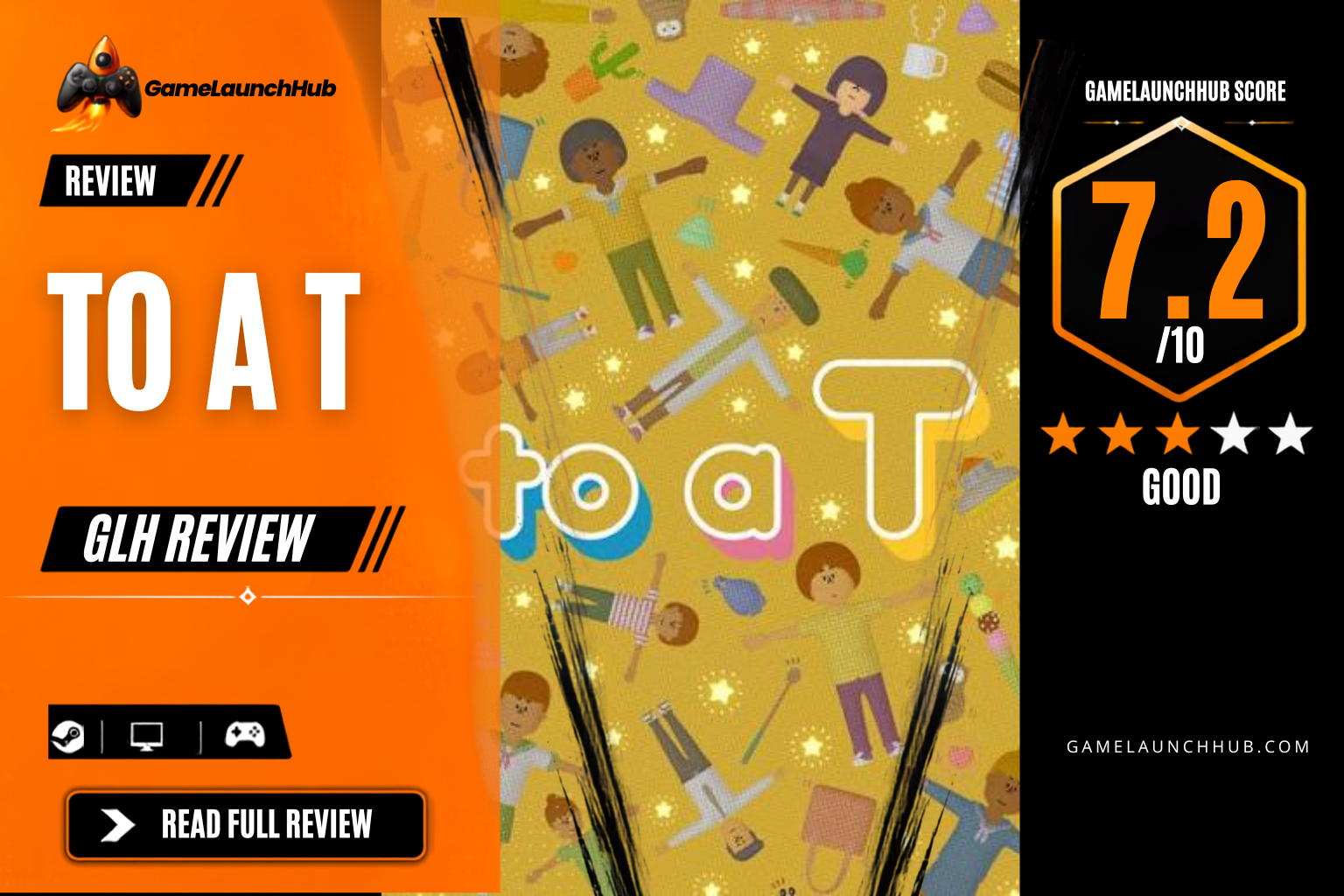
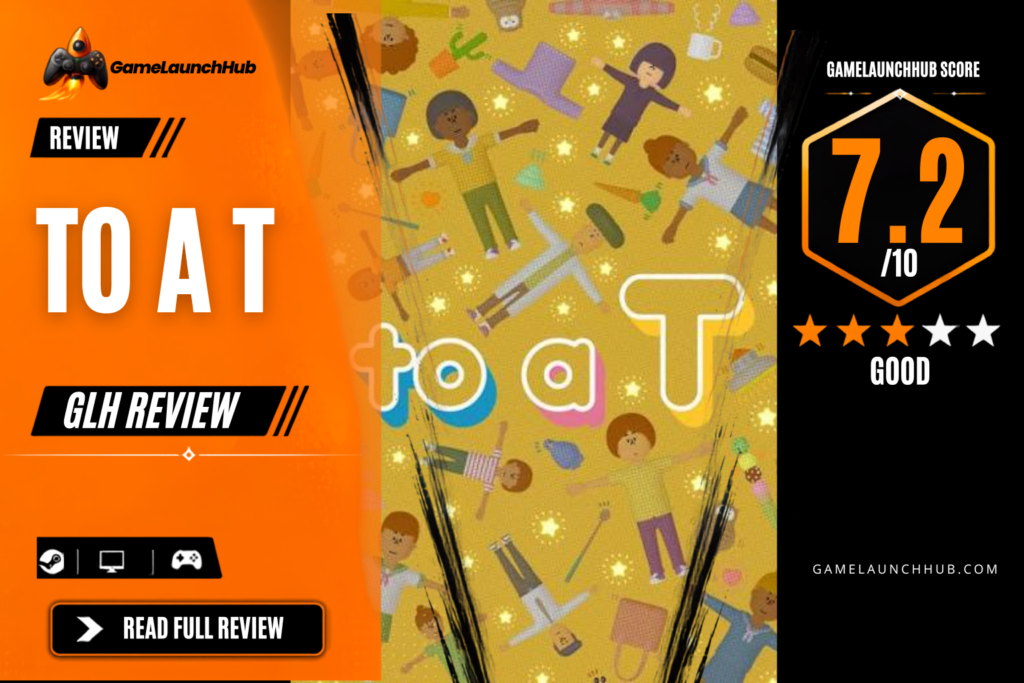
Our Take: After spending about five hours living Teen’s T-shaped life, we came away with a warm feeling and a head full of catchy songs. to a T is a game with a big heart and an important message about embracing difference and finding joy in imperfection. The first half is genuinely touching, the visuals are charming, and the music is unforgettable. But the second half loses its way, the gameplay becomes repetitive, and the camera controls are frustrating. It’s a game that’s perfectly imperfect, which, fittingly, is exactly what it’s trying to say.
Overall Score: 7.2 / 10
★★★☆☆
Verdict: GOOD
| Category | Score |
|---|---|
| Gameplay | 6.5 / 10 |
| Story & Presentation | 8.0 / 10 |
| Performance & Polish | 6.5 / 10 |
| Value for Money | 7.5 / 10 |
| Replayability | 6.0 / 10 |
FAQ
Is to a T worth buying?
Yes, if you appreciate narrative-driven games with a heartfelt message and don’t mind some gameplay roughness. The 4-5 hour runtime and $19.99 price point make it a reasonable investment for fans of Keita Takahashi’s unique style. However, if you prefer polished, mechanically deep games, you may want to look elsewhere.
Is to a T worth it on Switch 2?
The Switch 2 version is functional but compromised. Expect longer load times, occasional jitteriness, and reduced performance compared to other platforms. If portability is a priority, it’s still a solid option, but we recommend playing on PC or other consoles if possible.
How long to beat the odds?
The main story takes around 4-5 hours. If you take your time exploring, collecting coins, and buying outfits, you can stretch it to about 6 hours.
Is to a T worth full price to a T?
At $19.99, the game offers reasonable value for the experience. The 4-5 hour playtime, catchy songs, and heartfelt story make it a worthwhile purchase. However, if you’re concerned about the gameplay repetition or camera issues, consider waiting for a sale.
Is to a T about disability?
Yes, the game is widely interpreted as a metaphor for disability. A teen’s T-pose represents the experience of being different in a world not designed for you. However, some critics have noted that the game’s handling of the theme lacks nuance and its accessibility options are minimal.
Is To a T kid-friendly?
Yes, the game has a cartoonish art style and a positive message that’s appropriate for younger players. However, some minigames may be challenging for little ones, and the story’s second half gets quite bizarre.
Is it to a T like Katamari Damacy?
Not really. While both games share Keita Takahashi’s signature whimsy and weirdness, to a T is a narrative-driven adventure, while Katamari is a pure gameplay experience. Don’t go in expecting the same rolling mechanics.
Conclusion
to a T is a game that defies easy categorization. It’s a narrative adventure, a minigame collection, a disability metaphor, and a musical all rolled into one T-shaped package. It’s charming, heartfelt, and wonderfully weird, exactly what you’d expect from the creator of Katamari Damacy.
But it’s also a game with significant flaws. The gameplay is repetitive, the camera is frustrating, and the story loses its way in the second half. It’s a game that’s perfectly imperfect, which is fitting given its message about embracing difference and finding joy in imperfection.
For fans of Keita Takahashi’s unique vision, to a T is an easy recommendation. For everyone else, it’s a charming but flawed experience that’s worth your time if you’re in the right mood. Just don’t expect it to change your life or to be able to forget its earworm songs.
Final recommendation: Buy it if you love quirky narrative adventures and can overlook some roughness. Otherwise, wait for a sale.
Read More: BrokenLore: Unfollow: Is It Worth It? Our Honest Verdict
One response to “to a T: Is It Worth It? Our Honest Verdict”
[…] to a T: Is It Worth It? Our Honest VerdictJuly 24, 2026 […]