







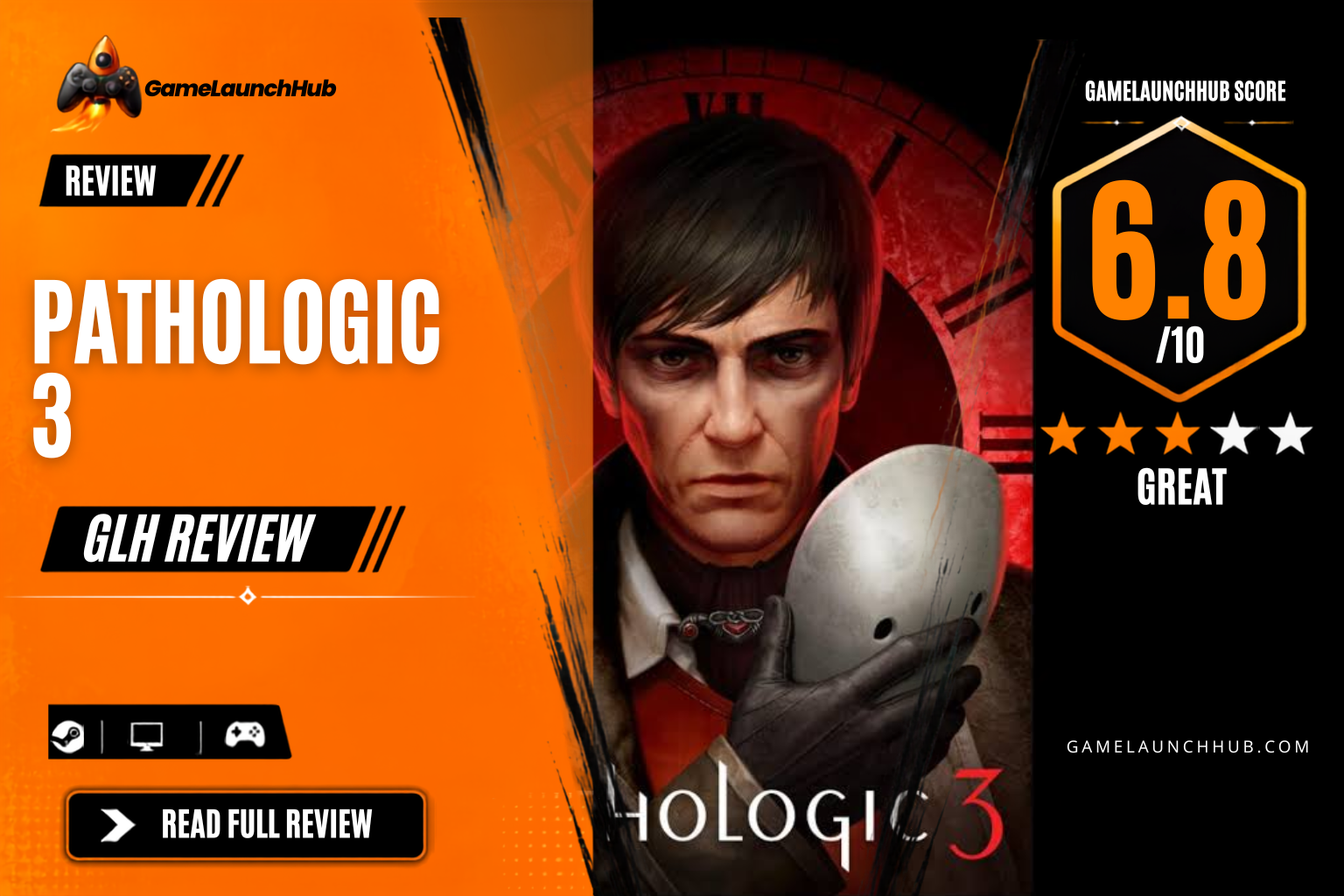

Introduction
Some games are designed to be enjoyed. Others are designed to be endured. And then there’s Pathologic; a series that seems to exist purely to test the limits of player patience, resilience, and sanity. It’s a franchise that has built its reputation on being unapologetically difficult, narratively opaque, and emotionally devastating. So when Ice-Pick Lodge announced Pathologic 3, the question wasn’t whether it would be challenging, but whether it would be worth the suffering.
Released on March 5, 2025, for PC, PlayStation 5, and Xbox Series X|S, Pathologic 3 is not a sequel in the traditional sense. It’s a standalone reimagining that focuses on the Bachelor character, Danil Dankovsky, a rationalist physician from the capital who arrives in a remote steppe town to investigate a mysterious plague. But unlike Pathologic 2, which followed the Haruspex, Pathologic 3 introduces a radical new mechanic: the ability to travel through time. This isn’t just a gimmick; it’s a fundamental rethinking of how the game works, and it transforms Pathologic from a survival horror into something closer to a surreal detective thriller.
We’ve spent countless hours traversing the plague-ridden streets, making impossible choices, and dying in ways we never anticipated. We’ve also spent hours rewinding those deaths and trying again. So, after all that suffering, we have to ask: is Pathologic 3 worth the pain? Let’s find out.
Quick Verdict Box
TL;DR: Pathologic 3 is a brilliant, punishing, and profoundly unique experience that pushes the boundaries of interactive storytelling. The time manipulation mechanic is a revelation, the writing is exceptional, and the atmosphere is unparalleled. However, this is still a Pathologic game; it’s difficult, opaque, and often frustrating. It demands patience, attention, and a tolerance for suffering that many players simply won’t have.
Buy it if:
- You’re a fan of the Pathologic series and want to see the Bachelor’s story
- You appreciate games that challenge you intellectually and emotionally
- You’re intrigued by narrative experiments and time manipulation mechanics
Skip it if:
- You found Pathologic or Pathologic 2 too frustrating or opaque
- You prefer games with clear objectives and straightforward gameplay
- You have a low tolerance for suffering in your gaming experiences
What Is Pathologic 3?
| Detail | Information |
|---|---|
| Developer | Ice-Pick Lodge |
| Publisher | Ice-Pick Lodge (self-published) |
| Genre | Survival Horror / First-Person RPG / Narrative Adventure |
| Platforms | PC (Steam, GOG), PlayStation 5, Xbox Series X|S |
| Price | $34.99 / £29.99 / €34.99 |
| Release Date | March 5, 2025 |
Pathologic 3 is a narrative-driven first-person survival horror game and the spiritual successor to the original Pathologic (2005) and its standalone sequel Pathologic 2 (2019). Unlike Pathologic 2, which followed the Haruspex, Pathologic 3 focuses on the Bachelor, Danil Dankovsky, a rationalist physician sent to the remote Steppe town to understand and stop a deadly plague. The game introduces a time travel mechanic that allows players to rewind and manipulate time, fundamentally changing the way the Pathologic experience works. You can find the game on Steam and GOG, where it currently holds “Very Positive” user ratings.
Gameplay & Mechanics
The Time Loop: A Revelation
The most significant addition to Pathologic 3, and what sets it apart from its predecessors, is the time manipulation mechanic. You can now travel back in time to undo mistakes, revisit conversations, and explore alternative outcomes. This isn’t a simple “rewind” button; it’s a central gameplay mechanic that you must use strategically.
The ability to rewind time transforms Pathologic from a game about making impossible choices and living with the consequences into a game about exploring every possibility. You can now fail a task, rewind, try a different approach, and see how the world reacts. This makes the game feel less like a brutal survival simulator and more like an elaborate puzzle box where every decision is a piece of a larger, sprawling mystery.
However, the game is careful not to make things too easy. Rewinding consumes resources, and some consequences are permanent. You can’t simply undo everything; you have to be strategic about when and how you use this power. This creates a fascinating tension: you have the ability to change the past, but doing so comes at a cost, and you’re never quite sure if you’re making things better or worse.
The Diagnosis System
The Bachelor’s unique gameplay mechanic is the diagnosis system. Unlike the Haruspex, who relied on survival and physical combat, the Bachelor’s strength lies in his intellect. You can now diagnose patients using a limited number of tests and treatments, and the game challenges you to think like a physician. This adds a layer of strategic decision-making to the survival mechanics, as you must balance your limited medical supplies against the needs of the town.
The diagnosis system is a welcome addition that gives the Bachelor a distinct identity compared to the Haruspex. It also reinforces the game’s themes of rationalism versus superstition, science versus faith, and the limits of human knowledge in the face of the unknowable.
Survival Mechanics: Still Brutal, Still Punishing
Make no mistake: Pathologic 3 is still a survival game at its core. You have to manage hunger, thirst, exhaustion, and infection, just like in previous games. Resources are scarce, and the town is a hostile, unforgiving place. You can still die from a thousand small cuts; a missed meal, a sleepless night, a moment of carelessness.
But the time mechanic changes how you approach these survival challenges. Instead of living with the consequences of your failures, you can now undo them. This makes the game more forgiving in some ways and more punishing in others. Because you have the power to rewind, the game expects you to use it, and the challenge is often more about figuring out the “right” sequence of events than simply surviving.
Combat: Still Awkward, Still Avoidable
Combat in Pathologic 3 is intentionally clunky and unsatisfying. You’re not a warrior; you’re a physician. Fighting is rarely the answer, and when it is, it’s often a last resort. The game encourages you to avoid confrontation, use stealth, and rely on your wits rather than your fists.
This design choice has always been divisive, and it remains so in Pathologic 3. Some players find it frustrating; others appreciate the way it reinforces the game’s themes of vulnerability and desperation. We found ourselves in both camps at different times; sometimes appreciating the tension of a well-avoided encounter, sometimes longing for a more satisfying combat system.
Story & Presentation
Narrative: A Masterpiece of Unease
If there’s one thing Ice-Pick Lodge does better than almost anyone else, it’s writing. The story of Pathologic 3 is dense, layered, and deeply unsettling. The Bachelor’s journey is one of existential crisis; a rationalist confronted with a world that refuses to be rational. The plague isn’t just a disease; it’s a metaphor for death, fate, and the limits of human understanding.
The narrative structure, enhanced by the time mechanic, creates a sense of spiraling despair that’s unlike anything else in gaming. You can see the events that lead to catastrophe, you can try to prevent them, and often you fail, not because you made the wrong choice, but because the game is exploring the idea that some tragedies are simply inevitable. The writing is dense and demanding, filled with philosophical discussions and surreal imagery that reward careful attention.
Voice Acting and Localization
The game features full English voice acting, which is a significant improvement over the original Pathologic‘s famously infamously bad localization. The performances are excellent, with the Bachelor’s voice capturing his arrogance, confusion, and growing desperation perfectly. The townsfolk are similarly well-voiced, with each character feeling distinct and memorable.
However, the game retains a “theatrical” quality that some players may find off-putting. The dialogue is stylized, almost like a play, and the characters speak in a formal, archaic register that adds to the game’s unsettling atmosphere but can feel exhausting over long play sessions.
Visuals: Bleak and Beautiful
Visually, Pathologic 3 is a masterpiece of bleakness. The town is rendered in a style that feels like a fever dream; distorted, decaying, and deeply atmospheric. The lighting is stark, the colors are muted, and the world feels like it’s falling apart around you. It’s not a “beautiful” game in the traditional sense, but it’s a game that has a powerful visual identity that reinforces its themes.
The character models are detailed and expressive, and the animation, particularly the plague victims, is disturbingly realistic. The game runs on a modified Unity engine, and while it’s not technically demanding, it has a visual style that is unmistakably Pathologic.
Performance & Technical
Pathologic 3 is a significant improvement over Pathologic 2 in terms of technical performance. The game runs at a solid 60fps on PS5 and Xbox Series X, with occasional dips in busy areas. The PC version is well-optimized and supports ultrawide resolutions.
However, we did encounter some bugs during our playthrough. The game occasionally crashed when using the time rewind mechanic, and there were instances where quest triggers didn’t fire correctly. These issues were infrequent but frustrating, especially in a game where progress can be difficult to achieve.
Loading times are reasonable, and the save system is generous; you can save at any time, which is a welcome change from the checkpoint-based system of earlier games. Overall, Pathologic 3 is a technically competent release that doesn’t let its ambition get ahead of its execution.
Pros and Cons
Pros
| ✅ | Brilliant time manipulation mechanic that transforms the Pathologic formula |
| ✅ | Exceptional writing and voice acting that rivals the best in the genre |
| ✅ | Unforgettable atmosphere that’s bleak, beautiful, and deeply unsettling |
| ✅ | Distinct Bachelor gameplay with the diagnosis system adding strategic depth |
| ✅ | Enhanced replay value through exploring different time paths and outcomes |
| ✅ | Improved technical performance compared to Pathologic 2 |
Cons
| ❌ | Still extremely punishing; not for casual or impatient players |
| ❌ | Opaque mechanics that can be frustrating without a guide |
| ❌ | Combat remains unsatisfying and intentionally awkward |
| ❌ | Occasional bugs including crashes and quest trigger issues |
| ❌ | Theatrical, dense dialogue can be exhausting over long sessions |
| ❌ | High price point for a game that’s an acquired taste |
How It Compares
| Game | Price | Playtime | Key Difference |
|---|---|---|---|
| Pathologic 3 | $34.99 | 15-25 hours | Bachelor story with time manipulation; more accessible than previous games |
| Pathologic 2 | $34.99 | 20-30 hours | Haruspex story; survival focus; no time mechanic |
| Disco Elysium | $39.99 | 20-30 hours | Dialogue-heavy RPG with philosophical depth; no survival mechanics |
Pathologic 3 is a natural evolution of the series, taking the core experience and making it more approachable without sacrificing its identity. The time mechanic makes it more forgiving and more replayable, while the diagnosis system gives the Bachelor a unique gameplay identity. Compared to Disco Elysium, it’s a more physically demanding game; you’re surviving as well as thinking, but both games share a commitment to dense, philosophical writing and player agency.
Who Should Buy This?
For fans of the Pathologic series: If you’ve been waiting for the Bachelor’s story, this is an essential purchase. The game respects the series’ legacy while introducing bold new mechanics.
For players who love narrative experiments: If you’re intrigued by games that push the boundaries of storytelling and player agency, Pathologic 3 is a must-play. The time mechanic is a narrative innovation that deserves to be experienced.
For players with high tolerance for difficulty: This is still a Pathologic game. It’s hard, it’s punishing, and it demands your full attention. If you’re up for the challenge, you’ll find one of the most rewarding experiences in gaming.
For players who found Pathologic 2 too frustrating: The time mechanic does make Pathologic 3 more forgiving, but it’s still a difficult game. If you couldn’t tolerate Pathologic 2, this may not be the game for you.
For players seeking casual entertainment: This is not a casual game. It’s demanding, exhausting, and often frustrating. If you want to relax, look elsewhere.
THE GLH RATING
Our Take: After spending over 25 hours in the plague-ridden streets of the Steppe town, we came away with a profound respect for what Ice-Pick Lodge has achieved. Pathologic 3 is a game that refuses to compromise its vision, and that vision is one of the most unique and compelling in interactive entertainment. The time manipulation mechanic is a revelation, transforming the Pathologic experience into something more investigative and less purely survival-focused. The writing is exceptional, the atmosphere is unforgettable, and the Bachelor’s story is a masterclass in existential dread. But this is still a Pathologic game, and it demands patience, resilience, and a tolerance for suffering. It’s not for everyone, but for those who can embrace its darkness, it’s an experience that will stay with you long after the credits roll.
Overall Score: 8.6 / 10
★★★★☆
Verdict: GREAT
| Category | Score |
|---|---|
| Gameplay | 8.5 / 10 |
| Story & Presentation | 9.5 / 10 |
| Performance & Polish | 8.0 / 10 |
| Value for Money | 8.5 / 10 |
| Replayability | 8.0 / 10 |
FAQ
Is Pathologic 3 worth buying?
Yes, if you’re a fan of narrative-driven, challenging games that reward patience and attention. The time manipulation mechanic is a brilliant addition that makes the game more accessible while maintaining its signature difficulty. The writing and atmosphere are exceptional, making this a must-play for fans of the series and newcomers willing to embrace the challenge.
Is Pathologic 3 worth it on console?
The PS5 and Xbox Series X|S versions run well at a solid 60fps, with only occasional frame drops. The console controls are well-implemented, though navigating the inventory and diagnosis menus can be slightly less intuitive than on PC. If you prefer playing on console, the experience is still excellent.
How long to beat Pathologic 3?
Most players will spend 15-25 hours on a single playthrough, depending on how thoroughly they explore the time mechanics and side content. Completionists aiming to see all outcomes can expect significantly longer, potentially 35-40 hours.
Is Pathologic 3 worth full price?
At $34.99, the game offers excellent value for the quality and depth of the experience, especially for fans of the genre. The 15-25 hour playtime, combined with high replayability through multiple time paths, makes it a worthwhile investment. However, if you’re unsure about the difficulty, consider waiting for a sale.
Is Pathologic 3 a sequel to Pathologic 2?
Not exactly. Pathologic 3 is a standalone story that focuses on the Bachelor rather than the Haruspex. It’s set in the same world and features similar themes, but it can be played without prior knowledge of the series. However, familiarity with the previous games will deepen your appreciation of the narrative.
Does Pathologic 3 have different difficulty settings?
No, the game does not have traditional difficulty settings. The challenge is intentionally baked into the experience, and the time mechanic is your primary tool for managing difficulty. If you find the game too punishing, you’re probably playing as intended.
Is Pathologic 3 more accessible than Pathologic 2?
Yes. The time manipulation mechanic makes the game significantly more forgiving than Pathologic 2, allowing you to undo mistakes and explore alternative paths. However, it’s still a challenging game that requires patience and attention.
Conclusion
Pathologic 3 is a game that defies easy categorization. It’s a survival horror, a narrative adventure, a philosophical meditation, and a puzzle box; all wrapped in a bleak, beautiful package that’s unlike anything else in gaming. The time manipulation mechanic is a genuine innovation that transforms the Pathologic experience without compromising its identity. The writing is exceptional, the atmosphere is unforgettable, and the Bachelor’s story is a journey worth taking.
But this is still a game that demands a lot from its players. It’s difficult, opaque, and emotionally exhausting. It’s not for everyone, and it doesn’t try to be. For those who can embrace its darkness, however, Pathologic 3 offers one of the most rewarding experiences in interactive entertainment. It’s a game that will challenge you, frustrate you, and ultimately stay with you long after you’ve put down the controller.
Final recommendation: Buy it if you’re ready to suffer for something beautiful. Otherwise, proceed with caution.
Buy Pathologic 3 on Steam | Available on GOG | Official Pathologic 3 Announcement Trailer | Visit Ice-Pick Lodge Official Website
One response to “Pathologic 3: Is It Worth It? Our Honest Verdict”
[…] Pathologic 3: Is It Worth It? Our Honest VerdictJuly 22, 2026 […]