


Final Fantasy VII Rebirth: Is It Worth It? Our Honest Verdict
Introduction
There are moments in gaming that feel like they shouldn’t be possible. The original Final Fantasy VII was one of them, a 1997 epic that redefined what an RPG could be. And now, nearly three decades later, Square Enix has done it again. Final Fantasy VII Rebirth is a game that, by all reasonable expectations, should not exist. It’s a sprawling, open-world reimagining of the middle chapter of one of gaming’s most beloved stories, delivered with a level of ambition and polish that feels almost reckless in its scale.
This is the second installment in the Final Fantasy VII Remake trilogy, continuing the journey of Cloud Strife and his companions as they leave the oppressive steel of Midgar behind and venture into the wider world. The stakes are higher, the scope is grander, and the emotional weight is heavier. We’ve spent dozens of hours exploring every corner of this reimagined world, from the rolling Grasslands to the depths of the Gold Saucer. We’ve laughed at the absurdity of a dolphin companion being essential to plot progression and wept at scenes that recontextualize moments we thought we knew. So, after all that, we have to ask: is Final Fantasy VII Rebirth worth your time and money? Let’s break it down.
Quick Verdict Box
TL;DR: Final Fantasy VII Rebirth is a breathtaking, emotionally resonant masterpiece that somehow manages to exceed the impossibly high expectations set by its predecessor. The combat is deeper and more satisfying, the world is vast and alive, and the character work is nothing short of extraordinary. However, significant technical issues across all platforms, from PC stuttering to Switch 2 visual compromises, and a narrative that occasionally buckles under its own ambition prevent it from achieving perfection.
Buy it if:
- You loved Final Fantasy VII Remake and want to continue the journey
- You appreciate deep, strategic combat with endless customization
- You’re ready to invest 60-150 hours in one of the most ambitious RPGs ever made
Skip it if:
- You haven’t played Final Fantasy VII Remake (this is a direct sequel)
- Technical performance issues are a deal-breaker for you
- You prefer tight, linear experiences over sprawling open-world content
What Is Final Fantasy VII Rebirth?
| Detail | Information |
|---|---|
| Developer | Square Enix Creative Business Unit I |
| Publisher | Square Enix |
| Genre | Action Role-Playing Game |
| Platforms | PC (Steam), PS5, Xbox Series X|S, Nintendo Switch 2 |
| Price | $69.99 / £59.99 / €69.99 (Standard); $94.99 (Digital Deluxe) |
| Release Date | June 3, 2026 (Switch 2, Xbox); 2025 (PC); 2024 (PS5) |
Final Fantasy VII Rebirth is the second installment in the Final Fantasy VII Remake trilogy, following Cloud Strife and his allies as they pursue Sephiroth across the planet. It features a massive open world divided into multiple zones, a refined combat system, dozens of mini-games, and a narrative that both honors and subverts the 1997 original. The game originally launched on PS5 in 2024 to universal acclaim, earning a 93 on Metacritic and becoming the second-highest-rated Final Fantasy game of all time. It has since been ported to PC, Xbox Series X|S, and Nintendo Switch 2.
Gameplay & Mechanics
Combat: A Perfect Evolution
The combat in Rebirth builds on the foundation of Remake in ways that feel both natural and revolutionary. The hybrid action-ATB system returns, but it’s been refined and expanded with new mechanics that give players more control and flexibility than ever before.
The “Folio” system is a major addition, allowing for deep character customization through unlockable abilities and passive bonuses. Each character now feels more distinct and powerful in their own right. Cloud’s swordplay is sharper and more fluid. Tifa’s martial arts are faster and more devastating. And the new party members, including the previously optional Yuffie and the beloved Red XIII, are fully integrated into the combat system with unique playstyles that add fresh strategic layers.
The Synergy system, introduced in Remake, has been expanded with new abilities that require teamwork to execute. These powerful attacks not only deal massive damage but also create opportunities for even more devastating follow-ups. We found ourselves constantly experimenting with different party compositions and synergy combinations, and the depth of the system kept us engaged for our entire 80+ hour playthrough.
As one reviewer put it, “Combat is like crack. They made Cloud so insanely fun, and everything just flows so well.” Another noted that Rebirth features a “perfect mix of Classic and Modern RPGs,” successfully bridging the gap between the turn-based roots of the franchise and the action-oriented demands of modern gaming.
The Open World: A Blessing and a Curse
Rebirth marks a dramatic departure from Remake‘s linear structure. Instead of the claustrophobic corridors of Midgar, you’re given massive, open zones to explore at your leisure. The Grasslands alone can occupy 5-10 hours of your time if you’re a completionist.
The world is packed with activities: side quests, world intel, monster hunts, treasure hunts, and an almost overwhelming number of mini-games. The variety is impressive, and the world feels alive in ways that few RPGs manage to achieve. However, this abundance comes with a cost. The open-world content can feel like “padding” and “busywork” that “destroy the pacing.” Some players have criticized the side content as “repetitive, uninspired, and barely connected to the story in any meaningful way.”
The game is a “theme park” experience. If you treat it as a collection of attractions to be enjoyed at your own pace, you’ll have a blast. If you feel compelled to complete every icon on the map, you may find yourself exhausted long before the credits roll.
Mini-Games: A Blessing and a Curse, Part Two
Rebirth is notoriously minigame heavy. From the return of the Gold Saucer’s attractions to new additions like the card game Queen’s Blood, the game is absolutely stuffed with diversions. The mini-games are, in many cases, genuinely fun and add welcome variety to the core loop. Queen’s Blood, in particular, has been praised as a surprisingly deep and addictive card game.
However, some mini-games are mandatory for story progression, and others are required for the Platinum Trophy, which demands “perfection in every facet of the game.” The sheer number of mini-games has been described as “notoriously mini-game heavy” and a source of “divisive” opinion among players. We found ourselves loving some mini-games and dreading others, and the inconsistency was a minor frustration in an otherwise stellar experience.
Story & Presentation
Narrative: A Reimagining That Risks Everything
The story of Rebirth is where the game’s ambition is most apparent, and most divisive. This is not a simple remake. It’s a “reimagining” that stays faithful to the larger concepts of the original while making “drastic changes to the game’s story.”
The emotional core of the narrative is the characters. Cloud’s arc is given deeper insight and more nuance. His relationships with his companions are expanded in ways that make the eventual emotional beats land with devastating impact. As one reviewer noted, “There is an Aerith scene toward the end of Rebirth that genuinely made me tear up.” The voice acting across the board is exceptional, with Briana White and Cody Christian delivering “masterful” performances.
The game “straddles cartoonish absurdity and gritty seriousness” with surprising grace. One moment you’re dealing with the traumatic aftermath of a village burned to the ground, and the next you’re befriending an adorable dolphin. In a lesser game, this tonal whiplash would be jarring. In Rebirth, it feels intentional, even charming.
However, the narrative is not without its problems. The pacing can be “indulgently sluggish” at times, and the open-world structure means that the main story can feel disconnected from the side content. The most controversial element is the ending, which has been described as “divisive.” The story “leaves a few loose ends dangling,” which is understandable given that this is the middle chapter of a trilogy. But some players felt that the narrative “falters in its pacing towards the end.”
Visuals: A Technical Marvel (With Caveats)
Visually, Rebirth is stunning. The character models are “incredibly detailed,” the environments are lush and varied, and the cinematic direction is on par with the best blockbuster films. The game “retains the remake project’s modern cinematic vision for Final Fantasy VII’s story.”
However, the visual fidelity varies dramatically depending on your platform. The PS5 version is a technical showcase. The PC version offers “better image quality and quadruple the frames” but suffers from significant stuttering issues. The Switch 2 port, while “one of the most impressive Nintendo Switch 2 ports ever released,” makes “compromises” with “soft” environmental textures and a lower frame rate.
Audio: A Masterclass in Sound
The music in Rebirth is a triumph. The soundtrack “greatly expands” on the original while “keeping the same feel.” The voice acting is “excellent,” and the sound design is immersive and impactful. The audio experience is consistently outstanding across all platforms.
Performance & Technical
This is where Rebirth becomes complicated. The game is a technical achievement, but it’s also a technical mess depending on where you play it.
On PC: The PC port has “promise but too many problems.” Shader compilation stuttering is a major issue, especially on lower-spec CPUs. Players have reported “flickering geometry, textures refusing to load, and even a sustained black screen.” The game has no shader pre-compilation step, which is a significant oversight. Modders have stepped in to fix these issues, but Square Enix has yet to implement official patches.
On PS5: The original version remains the gold standard. It runs smoothly, looks incredible, and offers the most polished experience. However, the Platinum Trophy is “brutal,” requiring “perfection in every facet.”
On Xbox Series X| S: Performance is comparable to PS5, with solid frame rates and high visual fidelity.
suit.” On Nintendo Switch 2: The port is “a miracle.” It’s “one of the best Switch 2 ports ever released.” However, there are “noticeable performance and visual concessions.” The game runs at a lower frame rate with softer textures, but “the game never gets choppy or feels like it lags.” The overall experience is “engaging and enjoyable,” but “technical excellence is not the Switch 2’s strong suit.”
On Steam Deck: Performance is mixed, with some players reporting playable experiences and others encountering significant issues.
Pros and Cons
Pros
| ✅ | Deep, satisfying combat with extensive customization options |
| ✅ | Exceptional character development and voice acting |
| ✅ | Massive, varied open world with countless activities |
| ✅ | Stunning visuals and cinematic presentation (on capable hardware) |
| ✅ | Masterful soundtrack that honors and expands the original |
| ✅ | Queen’s Blood is an addictive and surprisingly deep card game |
Cons
| ❌ | Significant PC performance issues including shader stuttering |
| ❌ | Visual compromises on Switch 2 compared to other platforms |
| ❌ | Open-world bloat and padding can feel exhausting |
| ❌ | Overwhelming number of mini-games, some mandatory |
| ❌ | Divisive narrative changes that may frustrate purists |
| ❌ | Brutal Platinum Trophy requiring near-perfect completion |
How It Compares
| Game | Price | Playtime | Key Difference |
|---|---|---|---|
| Final Fantasy VII Rebirth | $69.99 | 60-150+ hours | Open-world reimagining with deep combat and emotional story |
| Final Fantasy VII Remake Intergrade | $69.99 | 30-40 hours | Linear, Midgar-focused predecessor with tighter pacing |
| Final Fantasy XVI | $69.99 | 40-60 hours | Action-focused standalone with darker tone and real-time combat |
time. “Rebirth is a significant expansion over Remake in every way. It’s larger, more ambitious, and more emotionally resonant. However, its open-world structure and mini-game overload make it a more exhausting experience. Compared to Final Fantasy XVI, Rebirth offers more traditional RPG elements and a stronger connection to the franchise’s legacy. It’s “one of the greatest JRPGs of the last several years” and “easily one of the greatest remakes of all time.”
Who Should Buy This?
For fans of Final Fantasy VII Remake: This is an essential purchase. The story continues directly from where Remake left off, and the gameplay has been refined and expanded in almost every way. If you loved the first game, you will love this one.
For fans of deep, strategic RPG combat: The combat system is one of the best in the genre. The Folio system, Synergy attacks, and character-specific mechanics create endless strategic possibilities.
For players who love open-world exploration: The world of Rebirth is vast and filled with secrets. If you enjoy getting lost in a beautifully realized game world, you’ll find hundreds of hours of content here.
For players sensitive to technical issues: The PC version has significant performance problems, and the Switch 2 version requires visual compromises. If you want the best experience, play on PS5 or Xbox Series X|S.
For players who prefer tight, linear narratives: The open-world structure and sheer volume of side content can feel overwhelming. If you prefer focused, story-driven experiences, you may find Rebirth exhausting.
THE GLH RATING
Our Take: After spending over 80 hours exploring every corner of this reimagined world, we came away with a profound appreciation for what Square Enix has achieved and a deep frustration with what they’ve failed to fix. Final Fantasy VII Rebirth is a masterpiece of storytelling, character work, and combat design. The emotional beats land with devastating impact, the voice acting is extraordinary, and the sheer scope of the experience is breathtaking. But the technical issues, particularly on PC, are inexcusable. The open-world padding can feel exhausting, and the mini-game overload is a genuine flaw. This is a game that reaches for the stars and mostly grabs them, but it stumbles on the way up.
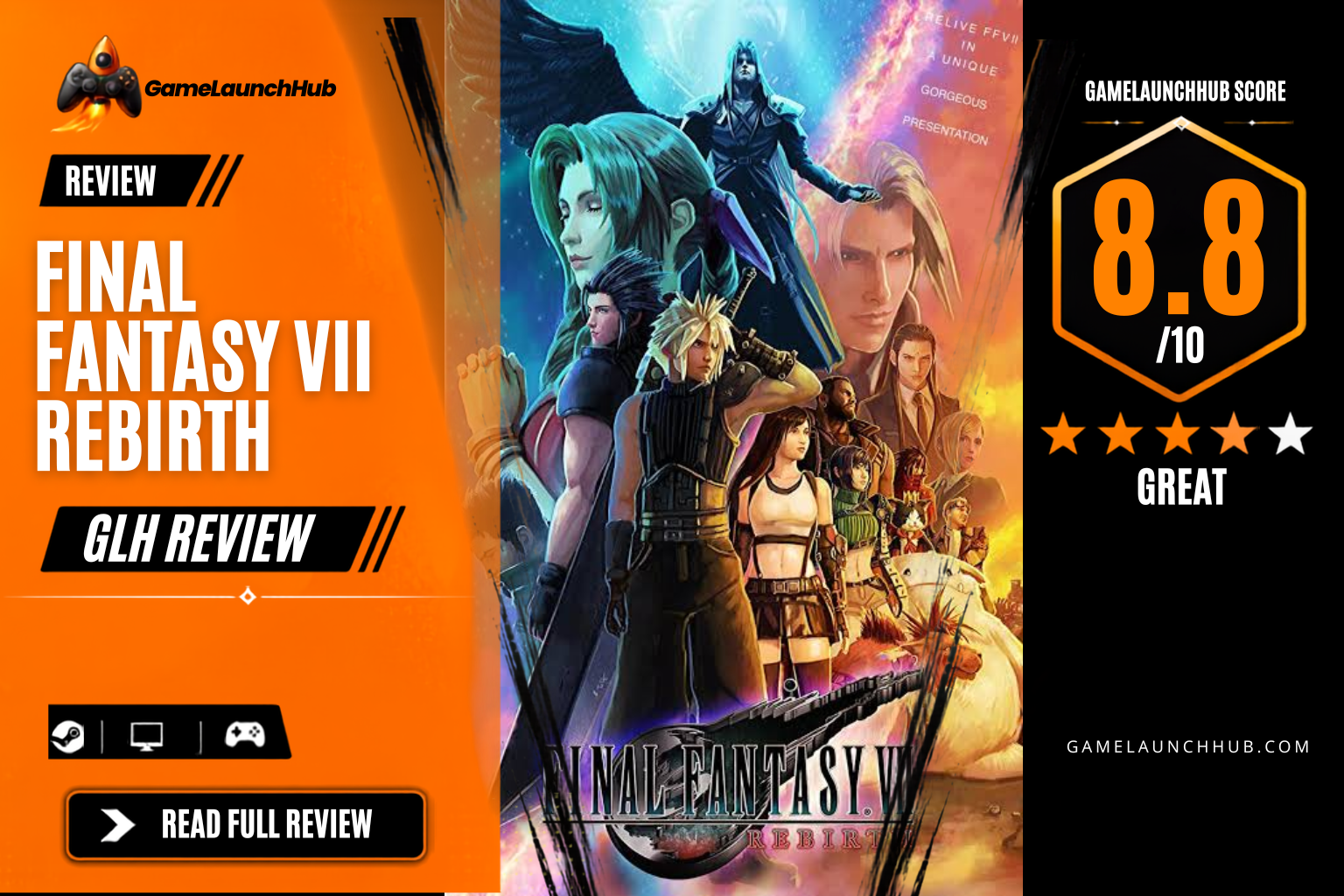
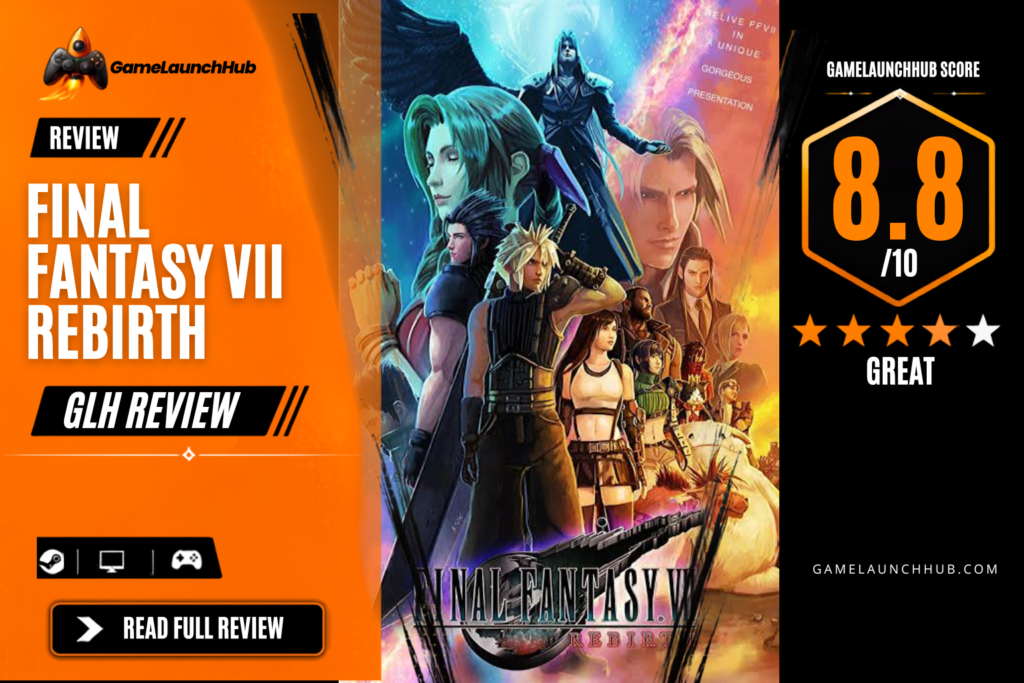
Overall Score: 8.8 / 10
★★★★☆
Verdict: GREAT
| Category | Score |
|---|---|
| Gameplay | 9.0 / 10 |
| Story & Presentation | 9.5 / 10 |
| Performance & Polish | 7.0 / 10 |
| Value for Money | 8.5 / 10 |
| Replayability | 9.0 / 10 |
FAQ
Is Final Fantasy VII Rebirth worth buying?
Yes, absolutely, if you have the right hardware. If you’re playing on PS5 or Xbox Series X|S, this is an essential purchase. The combat is exceptional, the story is emotionally devastating, and the world is vast and beautiful. If you’re playing on PC, be prepared for significant performance issues, including shader stuttering and texture problems. If you’re playing on Switch 2, expect visual compromises but a still-impressive portable experience. The PS5 version has a 93 Metacritic score, making it one of the highest-rated Final Fantasy games ever.
Is Final Fantasy VII Rebirth worth it on Switch 2?
Yes, if portability is your priority. The Switch 2 port is “one of the most impressive Nintendo Switch 2 ports ever released,” with solid performance and gorgeous character models. However, there are “noticeable performance and visual concessions,” including softer textures and a lower frame rate. It’s “the superior way to play portably,” but it’s not the best way to experience the game.
How long to beat Final Fantasy VII Rebirth?
The main story takes around 40-50 hours. The main story plus extras runs about 80-100 hours. Completionist runs can exceed 150 hours. There is an almost overwhelming amount of content in this game.
Is Final Fantasy VII Rebirth worth full price?
At $69.99, the game offers exceptional value for the sheer amount of content. The 60-150+ hour playtime, deep combat system, and emotionally resonant story make it a worthwhile investment. However, if you’re playing on PC, the performance issues may make the experience feel less polished than it should be.
Do I need to play Final Fantasy VII Remake first?
Yes. Rebirth is a direct continuation of Remake‘s story. Jumping in without playing the first game will leave you confused and disconnected from the narrative. As one review put it, “It’s essential you play Remake if you want to hit the ground running plot-wise.”
Is the ending of Final Fantasy VII Rebirth divisive?
Yes. The narrative changes and the ending have been described as “divisive.” Some players love the bold reimagining, while others feel it betrays the spirit of the original. The story “leaves a few loose ends dangling,” which is expected given that this is the middle chapter of a trilogy. But the ending has sparked significant debate among fans.
Does Final Fantasy VII Rebirth have performance issues on PC?
Yes. The PC version has significant performance problems, including shader compilation stuttering, texture loading issues, and flickering geometry. The game has no shader pre-compilation step. Community mods can help, but official patches are still needed.
Conclusion
Final Fantasy VII Rebirth is a game that should not exist. It’s too ambitious, too sprawling, and too emotionally demanding to have been pulled off successfully. And yet, against all odds, Square Enix has done it. This is a breathtaking reimagining of one of gaming’s most beloved stories, delivered with a level of craft and care that is genuinely awe-inspiring.
The combat is the best the series has ever offered. The characters are more fully realized than ever before. The world is vast, beautiful, and packed with secrets. The emotional beats land with devastating impact. This is a game that will make you laugh, cry, and fall in love with these characters all over again.
But it’s also a game with significant flaws. The PC version is a technical mess. The open-world padding can feel exhausting. The mini-game overload is a genuine issue. And the divisive narrative changes will frustrate purists.
For those who can look past these issues, or who are playing on the right hardware, Final Fantasy VII Rebirth is one of the greatest RPGs ever made. It’s a game that honors its legacy while boldly forging its own path. It’s a game that demands your time, your attention, and your heart. And it rewards you with one of the most unforgettable experiences in gaming.
Final recommendation: Buy it if you have a PS5 or Xbox Series X|S. Approach with caution on PC or Switch 2.
Read More: The Adventures of Elliot Review: Is It Worth Playing?
One response to “Final Fantasy VII Rebirth Review: Is It Worth It?”
[…] Final Fantasy VII Rebirth Review: Is It Worth It?July 27, 2026 […]