





Introduction
What if the moon disappeared every time you looked away? What if the people you loved ceased to exist the moment you stopped watching them? These are the unsettling questions at the heart of Cassette Boy, a puzzle adventure RPG that takes the famous Einstein quote about quantum observation and turns it into a full-fledged gameplay mechanic. Developed by solo creator Wonderland Kazakiri and published by Pocketpair Publishing, this indie gem launched on January 15, 2026, for PC, Nintendo Switch, PlayStation 4, PlayStation 5, Xbox One, and Xbox Series X|S. It has drawn inevitable comparisons to classics like The Legend of Zelda and Fez, while carving out its own identity with a distinctive Game Boy-inspired aesthetic and a mind-bending “Schrödinger System.”
At first glance, Cassette Boy looks like a charming pixel-art homage to 90s gaming. You wake up in a small town, greet your mother, and step into a world that feels instantly familiar to anyone who has played Pokémon or an early Zelda title. But that familiarity is a trap. The game’s core twist, that anything you cannot see simply stops existing, transforms a nostalgic throwback into something far more inventive. We’ve spent considerable time rotating the world, making obstacles vanish, and uncovering the mystery of the vanished moon. So, after all that, we have to ask: is Cassette Boy worth your time? Let’s find out.
Quick Verdict Box
TL;DR: Cassette Boy is a clever, inventive puzzle adventure that uses perspective-shifting mechanics to create genuinely satisfying brain-teasers. Its Game Boy-inspired visuals and chilled-out chiptune soundtrack create a dreamy, nostalgic atmosphere. However, the game’s short runtime, vague narrative, and occasional lack of guidance hold it back from reaching the heights of its inspirations.
Buy it if:
- You love perspective-based puzzle games like Fez or Monument Valley
- You appreciate retro Game Boy aesthetics and chiptune soundtracks
- You enjoy short, focused indie experiences that don’t overstay their welcome
Skip it if:
- You prefer games with clear direction and handholding
- You’re looking for a deep, narrative-driven RPG experience
- You dislike trial-and-error puzzle solving and getting lost
What Is Cassette Boy?
| Detail | Information |
|---|---|
| Developer | Wonderland Kazakiri Inc.. |
| Publisher | Pocketpair Publishing, Forever Entertainment (console ports) |
| Genre | Puzzle Action RPG |
| Platforms | PC (Steam), Nintendo Switch, PS4, PS5, Xbox One, Xbox Series X|S |
| Price | $14.99 / £13.49 / €14.99 |
| Release Date | January 15, 2026 |
Cassette Boy is a puzzle action RPG built around a simple but profound concept: “What you can’t see doesn’t exist.” The game looks like a 2D pixel-art adventure, but its world is actually 3D. By rotating the camera, you can change your perspective, causing objects, enemies, and even entire pathways to disappear or reappear. This “Schrödinger System” is the heart of the game, and every puzzle, combat encounter, and traversal challenge revolves around it. You can find the game on Steam, Nintendo Switch, and all major console storefronts.
Gameplay & Mechanics
The Schrödinger System: A Clever Core Mechanic
The genius of Cassette Boy lies in its central mechanic. The game is built around the idea that objects outside your field of view cease to exist. Press a shoulder button, and the entire world rotates on its axis, offering an entirely new viewpoint. This isn’t just a visual trick; it’s the key to solving every puzzle in the game.
Early on, you’ll encounter a simple example: a snail blocking your path. Instead of fighting it, you rotate the camera so the snail is no longer visible, and it simply stops existing. From there, the puzzles grow increasingly complex. You’ll need to hide buttons behind objects to keep them pressed, make spike traps disappear, and even rotate the camera a specific number of times to trigger devices. As one critic put it, “Cassette Boy is the closest I’ve ever gotten to playing a game that might actually rival Fez.” A detailed analysis by Thinky Games explores how the game’s inventive metaphysical mechanic both dazzles and vexes players.
What makes this system so satisfying is its consistency. The rules are simple and clearly communicated, but the applications are endlessly creative. We found ourselves constantly surprised by the clever ways the game forces you to think about perspective. It’s the kind of mechanic that makes you feel genuinely smart when you figure out a solution.
Combat: Functional but Basic
Combat in Cassette Boy is serviceable but never the focus. You’ll collect weapons like a bow and arrow to hit switches and enemies from a distance and cassette tapes that give you special abilities like seeing bombable walls or shrinking your character. The combat is simple and straightforward; you’ll slash at enemies, dodge their attacks, and occasionally use the perspective mechanic to make enemies disappear.
The boss battles are where combat gets more interesting. These encounters are built entirely around the Schrödinger System, requiring you to rotate the camera at specific moments to avoid attacks or reveal weak points. These fights are clever and memorable, but they’re also relatively few in number. Overall, combat is a supporting element rather than a primary draw.
Exploration and Progression: A Double-Edged Sword
The game features a relatively open world with a hub town, multiple dungeons, and caves to explore. Progression is neither fully linear nor truly open, which can be both a blessing and a curse. The freedom to explore is refreshing, but it also means you’ll often find yourself lost, unsure of where to go next.
The lack of a map is a particularly sore point. The game’s world is large enough that navigation can become confusing, and without any guidance, you may find yourself wandering in circles. One player noted, “If you have trouble remembering where you came from and where to go, it’s a nightmare.” This is a deliberate design choice, harkening back to the classics that inspired the game, but it’s also a source of frustration for modern players accustomed to more handholding.
Story & Presentation
Narrative: Familiar and Forgettable
The story of Cassette Boy is, to be generous, functional. You play as the titular Cassette Boy, a hero tasked with reassembling the fragments of the vanished moon. Along the way, you’ll meet mysterious characters, explore dungeons, and uncover the secrets of a world where observation determines reality.
The narrative draws clear inspiration from Zelda and Pokémon, with a home base town, a supportive mother, and a classic hero’s journey structure. However, the story never rises above its inspirations. The characters are charming but one-dimensional, the plot twists are predictable, and the emotional stakes feel low. As one review noted, the story “could have been fleshed out further.” This is a game that prioritizes mechanics over narrative, and while that’s not necessarily a flaw, it does mean the story won’t stick with you long after the credits roll.
Visuals: A Nostalgic Throwback
Visually, Cassette Boy is a love letter to the Game Boy era. Everything in the game has a green tint that evokes the original handheld’s monochrome screen. The pixel art is charming and detailed, with blocky 3D environments that recall early 3D games like Minecraft. A Zelda Universe article describes it as a “world-spinning, retro-style Zelda-like”.
The visual style is more than just nostalgia bait; it serves the gameplay. The limited color palette and clean pixel art make it easy to read the environment, which is crucial when you’re constantly rotating the camera and changing your perspective. The game’s aesthetic is cohesive and distinctive, giving it a unique identity that sets it apart from other indie puzzle games.
Audio: Chilled-Out Chiptune
The soundtrack is one of the game’s highlights. The chilled-out chiptune beats perfectly complement the dreamy, contemplative atmosphere. The music is never intrusive, but it’s always present, creating a sense of calm even during challenging puzzles. The sound effects are similarly well-designed, with satisfying audio cues for rotating the camera, solving puzzles, and defeating enemies.
Performance & Technical
Performance is generally solid across all platforms. The game’s low system requirements mean it runs smoothly even on older hardware. On consoles, the game performs well, with no significant frame drops or technical issues reported. The Switch version is particularly well-suited to the game’s pick-up-and-play nature, making it an ideal portable experience.
However, we did encounter some minor issues. The camera rotation can occasionally be disorienting, especially during boss battles, and there were a few instances where the game’s physics felt slightly off. These issues are infrequent and don’t significantly detract from the experience.
Pros and Cons
Pros
| ✅ | Brilliant Schrödinger System that creates genuinely clever puzzles |
| ✅ | Charming Game Boy-inspired visuals with a cohesive aesthetic |
| ✅ | Chilled-out chiptune soundtrack that enhances the dreamy atmosphere |
| ✅ | Satisfying puzzle design that rewards creative thinking |
| ✅ | Short, focused experience that doesn’t overstay its welcome |
| ✅ | Affordable price point at $14.99 |
Cons
| ❌ | Vague, forgettable narrative that lacks emotional depth |
| ❌ | No in-game map making, navigation confusing |
| ❌ | Short runtime (around 6-7 hours for the main story) |
| ❌ | Occasional lack of direction leading to frustrating aimless wandering |
| ❌ | Basic combat that never fully engages |
How It Compares
| Game | Price | Playtime | Key Difference |
|---|---|---|---|
| Cassette Boy | $14.99 | 6-7 hours | Perspective-shifting puzzle adventure with Game Boy aesthetic |
| Fez | $9.99 | 8-10 hours | Classic 2D/3D perspective puzzle platformer; more open-ended |
| The Legend of Zelda: Link’s Awakening | $59.99 | 12-15 hours | Full-fledged Zelda adventure with deep combat and narrative |
Cassette Boy is clearly inspired by Fez and Zelda, but it’s a more focused, streamlined experience than either. Compared to Fez, it’s more guided and story-driven, though it lacks that game’s sprawling, mysterious world. Compared to Zelda, it’s shorter, simpler, and more puzzle-focused, with less emphasis on combat and exploration. At $14.99, it’s positioned as a budget-friendly alternative to both.
Who Should Buy This?
For fans of perspective puzzle games: If you loved Fez, Monument Valley, or Superliminal, Cassette Boy will scratch that same itch. The Schrödinger System is genuinely inventive and satisfying.
For players who appreciate retro aesthetics: The Game Boy-inspired visuals and chiptune soundtrack are a love letter to 90s gaming. If you have nostalgia for that era, you’ll feel right at home.
For players seeking a short, focused experience: At 6-7 hours, Cassette Boy is a perfect weekend game. It doesn’t overstay its welcome and delivers a complete experience in a compact package.
For players who dislike getting lost: The lack of a map and occasional vague direction can be frustrating. If you prefer clear guidance, this may not be the game for you.
For players seeking a deep RPG: The RPG elements are minimal. If you’re looking for a narrative-driven epic with deep character progression, look elsewhere.
THE GLH RATING
Our Take: After spending over six hours exploring the quantum world of Cassette Boy, we came away impressed by its cleverness and charmed by its aesthetic. The Schrödinger System is a genuinely inventive mechanic that creates puzzles we haven’t seen anywhere else, and the Game Boy-inspired visuals and chilled-out soundtrack create a dreamy, contemplative atmosphere. However, the game’s short runtime, vague narrative, and occasional lack of direction prevent it from achieving greatness. It’s a smart, stylish puzzle game that’s well worth your time, but it’s not the masterpiece it could have been.
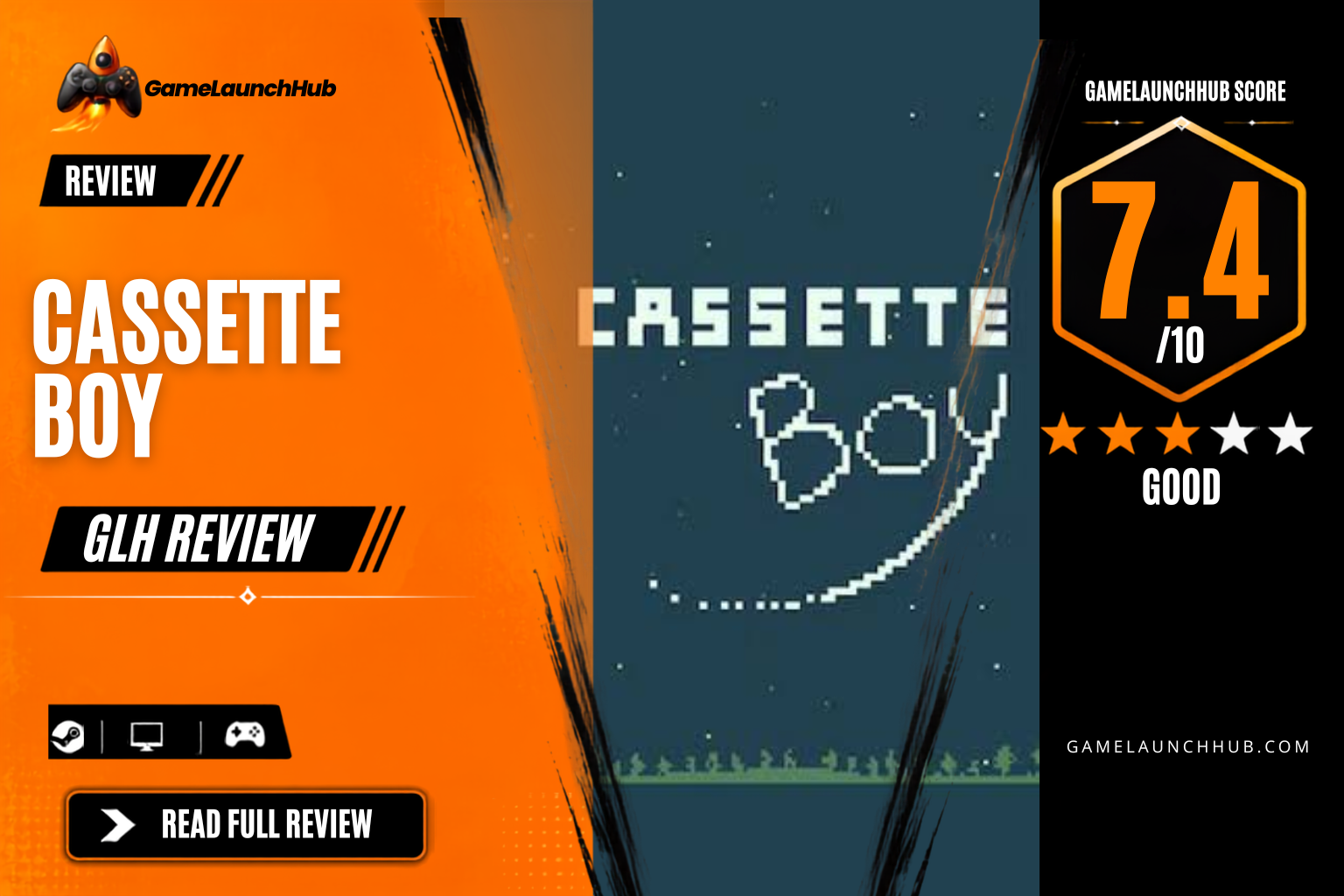
Overall Score: 7.4 / 10
★★★☆☆
Verdict: GOOD
| Category | Score |
|---|---|
| Gameplay | 8.0 / 10 |
| Story & Presentation | 6.5 / 10 |
| Performance & Polish | 7.5 / 10 |
| Value for Money | 7.5 / 10 |
| Replayability | 6.5 / 10 |
FAQ
Is Cassette Boy worth buying?
Yes, if you enjoy perspective-based puzzle games and appreciate retro aesthetics. The Schrödinger System is genuinely inventive, and the game offers a satisfying 6-7 hour experience at an affordable price. However, if you prefer games with clear direction and deep narratives, you may be disappointed. You can check the Metacritic page for additional context.
Is Cassette Boy worth it on Switch?
The Switch version is an excellent choice for the game’s pick-up-and-play nature. The performance is solid, and the portable form factor suits the game’s short, puzzle-focused sessions well. It’s one of the best ways to experience the game. Read the Nintendo Life review for more details.
How long to beat Cassette Boy?
Most players will complete the main story in 6-7 hours. Completionists aiming to find all collectibles and secrets can expect around 11-13 hours.
Is Cassette Boy worth full price?
At $14.99, the game offers reasonable value for the experience. The 6-7 hour playtime and inventive puzzle design make it a worthwhile purchase, especially for fans of the genre. If you’re unsure, consider trying the free demo on Steam first.
Is Cassette Boy like Fez?
Yes, the game draws clear inspiration from Fez in its perspective-shifting mechanics. However, Cassette Boy is more story-driven and guided than Fez, with a stronger focus on combat and RPG elements. A Rock Paper Shotgun preview described it as “Fez-esque.”
Does Cassette Boy have a map?
No, the game does not feature an in-game map. This is a deliberate design choice that harkens back to classic games, but it can make navigation confusing and frustrating at times.
Is Cassette Boy a full game or early access?
The game is a full release, not early access. However, the developers have indicated they plan to add more content, including new mechanics, monsters, and puzzles.
Conclusion
Cassette Boy is a game that understands the power of a single, well-executed idea. The Schrödinger System is a brilliant mechanic that creates puzzles you won’t find anywhere else, and the Game Boy-inspired aesthetic gives the game a distinctive identity that sets it apart from the crowded indie puzzle market. It’s a smart, stylish, and satisfying experience that’s perfect for a weekend playthrough.
But it’s also a game that could have been more. The narrative is forgettable, the combat is basic, and the lack of a map can be genuinely frustrating. It’s a game that prioritizes its clever central mechanic over almost everything else, and while that mechanic is strong enough to carry the experience, it leaves you wanting more depth and polish.
If you’re a fan of perspective puzzle games and appreciate retro aesthetics, Cassette Boy is well worth your time. Just don’t expect it to reinvent the wheel.
Final recommendation: Buy it if you love clever puzzle mechanics and retro vibes. Otherwise, wait for a sale.
Read More: Streetdog BMX: Is It Worth It? Our Honest Verdict
One response to “Cassette Boy: Is It Worth It? Our Honest Verdict”
[…] Cassette Boy: Is It Worth It? Our Honest VerdictJuly 23, 2026 […]