





Introduction
Thirteen games. Over two decades of interconnected storytelling. A fictional continent so meticulously detailed that it makes Middle-earth look like a hastily sketched napkin drawing. This is the world of Trails, a JRPG saga that has quietly built one of the most ambitious ongoing narratives in gaming history. And now, with The Legend of Heroes: Trails Beyond the Horizon, that narrative reaches a pivotal moment.
This is not a game for the faint of heart or the uninitiated. Developed by Nihon Falcom and published in the West by NIS America, Trails Beyond the Horizon is the 13th mainline entry in the series and the explosive conclusion to the Calvard arc that began with Trails through Daybreak. It brings together three protagonists from different corners of the franchise: Van Arkride, the Spriggan detective from the Daybreak games; Rean Schwarzer, the hero of the Cold Steel saga; and Father Kevin Graham, the star of Trails in the Sky the 3rd. Their paths intertwine around a central mystery: humanity’s first manned space flight, an event that could reveal the true nature of the world itself.
We’ve spent over 80 hours navigating the politics, the battles, and the endless dialogue of this sprawling epic. We’ve seen the slow-burn first act, the shocking revelations, and the emotional payoffs that only a franchise this long-running can deliver. So, after all that, we have to ask: is Trails Beyond the Horizon worth your time and money? Let’s break it down.
Quick Verdict Box
TL;DR: Trails Beyond the Horizon is a monumental achievement in long-form storytelling, delivering the kind of narrative payoffs that only a 13-game saga can provide. The combat is the best the series has ever offered, the characters are beloved, and the stakes are astronomical. However, its glacial pacing, dense lore, and absolute refusal to cater to newcomers make it one of the most impenetrable JRPGs ever made.
Buy it if:
- You are already a Trails fan and have played through the Calvard arc
- You love massive, text-heavy JRPGs with deep combat systems
- You want to experience the culmination of one of gaming’s most ambitious stories
Skip it if:
- You haven’t played any previous Trails games (start with Trails in the Sky instead)
- You dislike slow-paced narratives with hours of exposition
- You prefer shorter, more focused gaming experiences
What Is Trails Beyond the Horizon?
| Detail | Information |
|---|---|
| Developer | Nihon Falcom |
| Publisher | NIS America |
| Genre | JRPG / Narrative RPG |
| Platforms | PC (Steam, Epic Games Store, GOG), PS4, PS5, Nintendo Switch, Nintendo Switch 2 |
| Price | $59.99 / £49.99 / €59.99 |
| Release Date | January 15, 2026 (Western release) |
Trails Beyond the Horizon is the 13th main installment in the Trails series and the conclusion of the Calvard arc. Set in the Republic of Calvard, the game follows three protagonists across three intertwining story routes as they investigate a mysterious space program that may hold the key to the fate of the entire continent of Zemuria. The game was originally released in Japan as Kai no Kiseki in 2024 and has finally made its way to Western audiences.
Gameplay & Mechanics
The Hybrid Combat System: A Refined Masterpiece
The combat in Trails Beyond the Horizon is, without exaggeration, the best the series has ever seen. Building on the hybrid action-turn-based system introduced in Trails through Daybreak, the game offers two distinct battle modes that you can switch between on the fly.
Field Battles are real-time action sequences where you can freely attack enemies, dodge, and use special abilities. It’s fast, fluid, and surprisingly satisfying for a series traditionally known for turn-based combat. Certain characters, like Van with his Grendel transformation, can surge with extra strength during these encounters. You can also activate Z.O.C. (Zone of Control) to slow time and unleash devastating combos.
Command Battles are the classic turn-based system that Trails fans know and love, but with new layers of strategy. The Shard Command system lets you equip special abilities to your party, and S-Boosts provide a range of tactical benefits. The balance between the two modes is exceptional. As one analysis noted, this hybrid system is “better balanced than Metaphor ReFantazio’s,” offering meaningful choices in both styles rather than relegating action to simply mopping up weak enemies.
The Route System: Three Stories, One Epic
Taking a page from Trails into Reverie, Beyond the Horizon divides its narrative across three separate routes, each following one of the three protagonists: Van, Rean, and Kevin. You can play these routes in any order initially, though they eventually crystallize into more specific narrative arcs.
This structure is a significant improvement over Reverie‘s similar system. The pacing is snappier, the emotional moments hit harder, and each route has a distinct thematic identity. However, it also means you’ll be constantly switching between parties, which can be disorienting if you’re not paying close attention.
The Grim Garten: A Dungeon Worth Exploring
One of the standout additions is the Grim Garten, a side dungeon where you can assemble a custom party from characters across the entire franchise and take on Ouroboros’ machinations. This is a dream come true for longtime fans, allowing you to mix and match heroes from different arcs. It’s a “sublimely designed permanent side quest with a high degree of freedom and challenge, making it very fun and well worth the extra time you’ll pour into it”.
Story & Presentation
Narrative: The Payoff of a Lifetime
The story of Trails Beyond the Horizon is the reason this game exists. It’s the culmination of plot threads that have been building for over two decades, delivering revelations that fundamentally reshape our understanding of the world of Zemuria.
The premise is deceptively simple: the Calvard Republic is launching humanity’s first manned space flight, and the whole country is caught up in the excitement. But as Van, Rean, and Kevin dig deeper, they uncover a conspiracy that threatens the very existence of the continent.
The game’s greatest strength is its ability to deliver emotional payoffs that only a long-running series can provide. Characters from across the franchise return, not as cameos, but as integral parts of the story. The all-important world-building is expanded upon to a surprising degree, giving “welcome insight into matters that fans have been arguing over for ages”.
However, the narrative comes with a massive caveat: it is utterly impenetrable to newcomers. As one review put it, “If ever there was a Trails title created for absolutely no one but existing fans, this is it”. The game assumes you have intimate knowledge of not just the Daybreak games, but the Cold Steel saga, the Sky trilogy, and even the Crossbell duology. Jumping in here without that context would be “like watching the first episode of Game of Thrones before skipping straight to season 8”.
Pacing: The Slow Burn Problem
If there’s one consistent criticism of Trails Beyond the Horizon, it’s the pacing. The opening act is notoriously sluggish, spending too much time reintroducing a frankly shocking number of returning characters. The prologue alone can last over two hours. Even after that, the game suffers from “indulgently sluggish pacing” that will test the patience of all but the most devoted fans.
But here’s the thing: once you push through that slow start, the game becomes a relentless thrill ride. “Almost every chapter ends with an impressive bang, always keeping you guessing as to what the next twist might be”. The payoff is worth the investment, but that investment is significant.
Visuals and Audio: Falcom’s Signature Style
Visually, the game is a step up from previous entries, with more detailed environments and character models. The Calvard Republic is rendered with vibrant colors and impressive scale, from the bustling capital of Edith to the more remote regions. As one review noted, “this is one of the most beautiful Trails games yet”.
The soundtrack, composed by Falcom’s in-house team, is as excellent as ever. The orchestral score complements the game’s epic scope, with emotional piano pieces for the quieter moments and high-energy rock tracks for the battles. It’s a soundtrack that will stick with you long after you’ve finished the game.
Performance & Technical
Performance is generally solid across all platforms. The PS5 version runs at a smooth 60fps, and the PC version supports higher frame rates and resolutions. The system requirements are modest, with a GTX 1050 recommended for 1080p at 30fps and a GTX 1650 for 1440p at 60fps.
However, there are some technical issues worth noting. The Switch version, while functional, suffers from longer load times and reduced graphical fidelity. There have also been reports of occasional frame drops on all platforms during particularly busy scenes. These issues are minor and don’t significantly detract from the experience.
One point of contention is the localization. Some fans have raised concerns about certain translation choices. While we didn’t find these issues to be widespread, they are worth noting for purists.
Pros and Cons
Pros
| ✅ | Exceptional hybrid combat system that’s the best in the series |
| ✅ | Monumental narrative payoffs that reward longtime fans |
| ✅ | Beloved returning characters from across the franchise |
| ✅ | Grim Garten side dungeon offers deep, rewarding content |
| ✅ | Three-protagonist route system that improves on Reverie‘s formula |
| ✅ | Outstanding soundtrack that captures the game’s epic scope |
Cons
| ❌ | Impenetrable for newcomers; requires knowledge of multiple previous games |
| ❌ | Painfully slow first act that tests player patience |
| ❌ | Overly long exposition with dense, text-heavy dialogue |
| ❌ | Occasional technical issues including frame drops and localization concerns |
| ❌ | Reuses many locations from Daybreak I & II |
How It Compares
| Game | Price | Playtime | Key Difference |
|---|---|---|---|
| Trails Beyond the Horizon | $59.99 | 53-105 hours | 13th entry; concludes Calvard arc; three-protagonist system |
| Trails through Daybreak | $59.99 | 50-80 hours | First Calvard arc game; introduces Van and hybrid combat |
| Trails into Reverie | $59.99 | 40-80 hours | Epilogue to Cold Steel/Crossbell; three-route system |
Trails Beyond the Horizon is the natural evolution of everything Falcom has built over the past two decades. Compared to Daybreak, it offers more refined combat and a more ambitious narrative. Compared to Reverie, it improves the route system with better pacing and more meaningful character interactions. However, it’s also the most demanding entry in the series, requiring knowledge not just of the Calvard arc but of the entire franchise.
Who Should Buy This?
For longtime Trails fans: This is an essential purchase. If you’ve been following the series since Sky or even since Cold Steel, Beyond the Horizon delivers the kind of narrative payoffs that make the entire journey worthwhile. It’s “one of the greatest games in the entire franchise”.
For players who love deep JRPGs: Even beyond the story, the combat system is a masterclass in hybrid design. If you appreciate strategic, engaging battles, you’ll find plenty to love here.
For players who can tolerate slow pacing: This is not a game for the impatient. The first act is a slog, and the game is packed with dense, text-heavy exposition. If you can push through, the rewards are substantial.
For newcomers to the Trails series: Do not start here. Seriously. Start with Trails in the Sky or, at the very least, Trails through Daybreak. Jumping into Beyond the Horizon without context will leave you confused and frustrated.
For players seeking a shorter experience: With a main story clocking in at over 50 hours and completionist runs exceeding 100 hours, this is a massive commitment. If you prefer shorter games, look elsewhere.
THE GLH RATING
Our Take: After spending over 80 hours navigating the politics, battles, and endless dialogue of Trails Beyond the Horizon, we came away with a profound respect for what Falcom has achieved. This is a game that refuses to compromise its vision, delivering a narrative experience that is both breathtaking in its ambition and frustrating in its excess. The combat is the best the series has ever offered, the character moments are genuinely moving, and the revelations will leave longtime fans reeling. But the slow pacing, dense lore, and absolute refusal to cater to newcomers make it one of the most demanding games we’ve ever played. It’s a masterpiece for the faithful and a wall for everyone else.
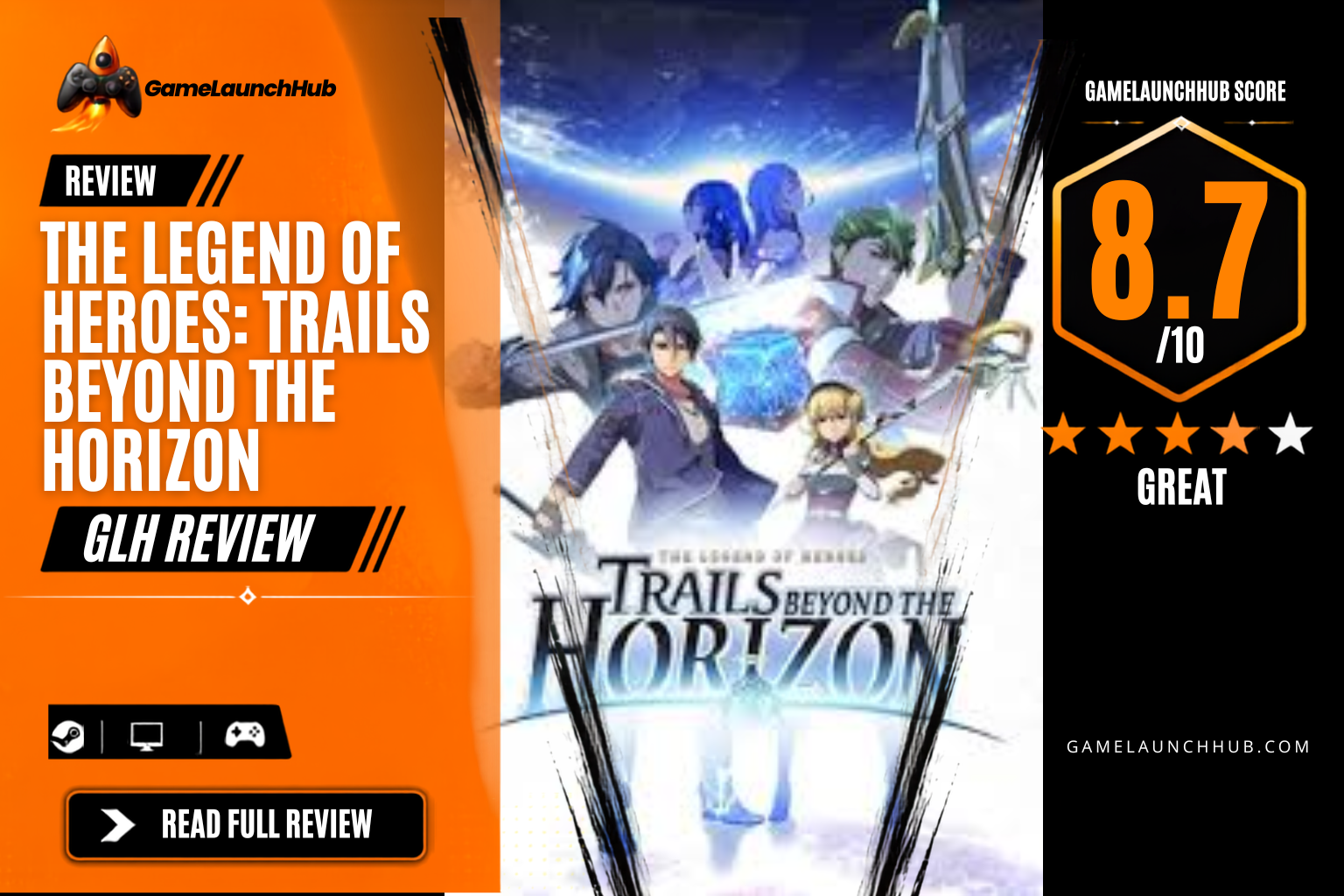
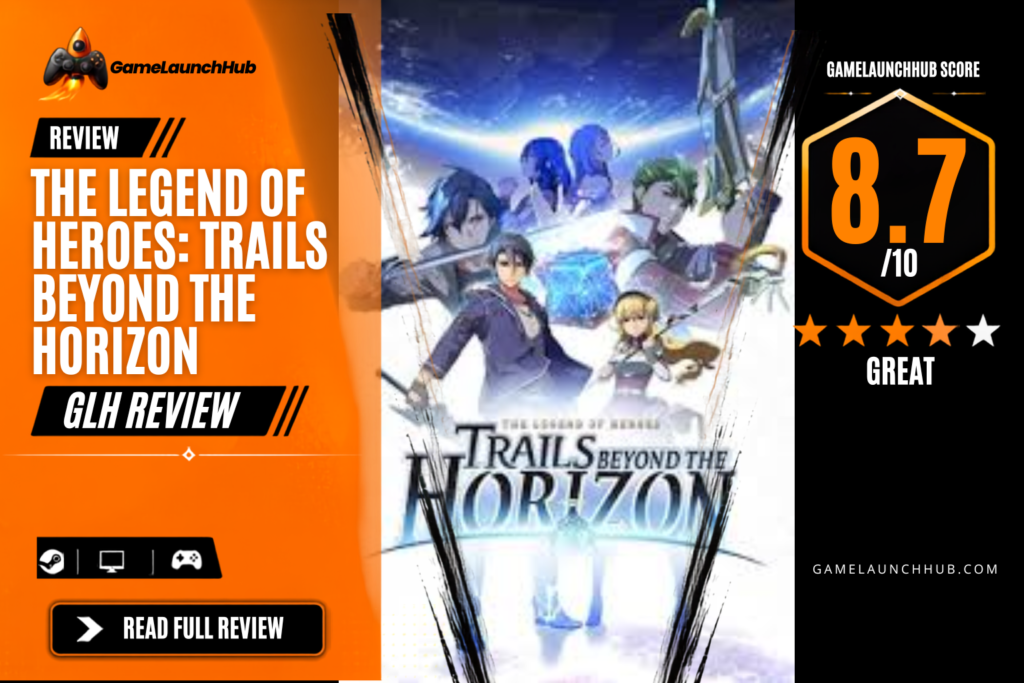
Overall Score: 8.7 / 10
★★★★☆
Verdict: GREAT
| Category | Score |
|---|---|
| Gameplay | 9.0 / 10 |
| Story & Presentation | 9.0 / 10 |
| Performance & Polish | 8.0 / 10 |
| Value for Money | 8.5 / 10 |
| Replayability | 8.5 / 10 |
FAQ
Is Trails Beyond the Horizon worth buying?
Yes, if you are already a Trails fan. This is the culmination of over two decades of storytelling, and it delivers the kind of narrative payoffs that only a series this long-running can provide. However, if you’re new to the franchise, this is absolutely not the place to start.
Is Trails Beyond the Horizon worth it on Switch?
The Switch version is functional but compromised. Expect longer load times and reduced graphical fidelity compared to the PS5 and PC versions. If portability is a priority, it’s still a solid option, but we recommend playing on more powerful hardware if possible.
How long to beat Trails Beyond the Horizon?
The main story takes around 53-55 hours. Main story plus extras runs about 81-85 hours, and completionist runs can exceed 105 hours. This is a massive game.
Is Trails Beyond the Horizon worth full price?
At $59.99, the game offers exceptional value for the sheer amount of content. Over 80 hours of gameplay, a deep combat system, and a narrative that rewards years of investment make it a worthwhile purchase for fans. For newcomers, however, the value proposition is much lower.
Do I need to play previous Trails games before this?
Yes. Absolutely yes. This game is the 13th main entry in the series and directly continues the story from Trails through Daybreak I & II. Jumping in here without context will leave you lost. Start with Trails in the Sky or, at minimum, Trails through Daybreak.
Is the combat system good?
The hybrid combat system is one of the game’s strongest features. It offers a fluid mix of real-time action and strategic turn-based battles that is “better balanced than Metaphor ReFantazio’s”.
What is the Grim Garten?
The Grim Garten is a side dungeon where you can assemble a custom party from characters across the entire franchise. It’s a “sublimely designed permanent side quest” that offers high replayability and is “very fun and well worth the extra time”.
Conclusion
The Legend of Heroes: Trails Beyond the Horizon is a game that defies easy categorization. It’s a monumental achievement in long-form storytelling, a masterclass in combat design, and a love letter to the fans who have stuck with the series for over two decades. It’s also slow, dense, and utterly impenetrable to anyone who hasn’t been on this journey from the beginning.
For longtime Trails fans, this is an essential purchase, a game that delivers on promises made years ago and sets the stage for the franchise’s future. For everyone else, it’s a reminder that some stories are not for the uninitiated.
If you’re ready to commit, if you have the patience for a slow burn and the appetite for dense, text-heavy exposition, Trails Beyond the Horizon will reward you with one of the most ambitious and emotionally resonant experiences in gaming. Just make sure you’ve done your homework first.
Final recommendation: Buy it if you’re a Trails fan. If you’re not, start with Trails in the Sky and we’ll see you in a few hundred hours.
One response to “The Legend of Heroes: Trails Beyond the Horizon: Is It Worth It? Our Honest Verdict”
[…] The Legend of Heroes: Trails Beyond the Horizon: Is It Worth It? Our Honest VerdictJuly 23, 2026 […]