






Written by Chen Xi, PC & Console Requirements Specialist at Game Launch Hub
Control Resonant System Requirements: PC Specs, PS5, Xbox Series X|S & Steam Deck Performance Guide
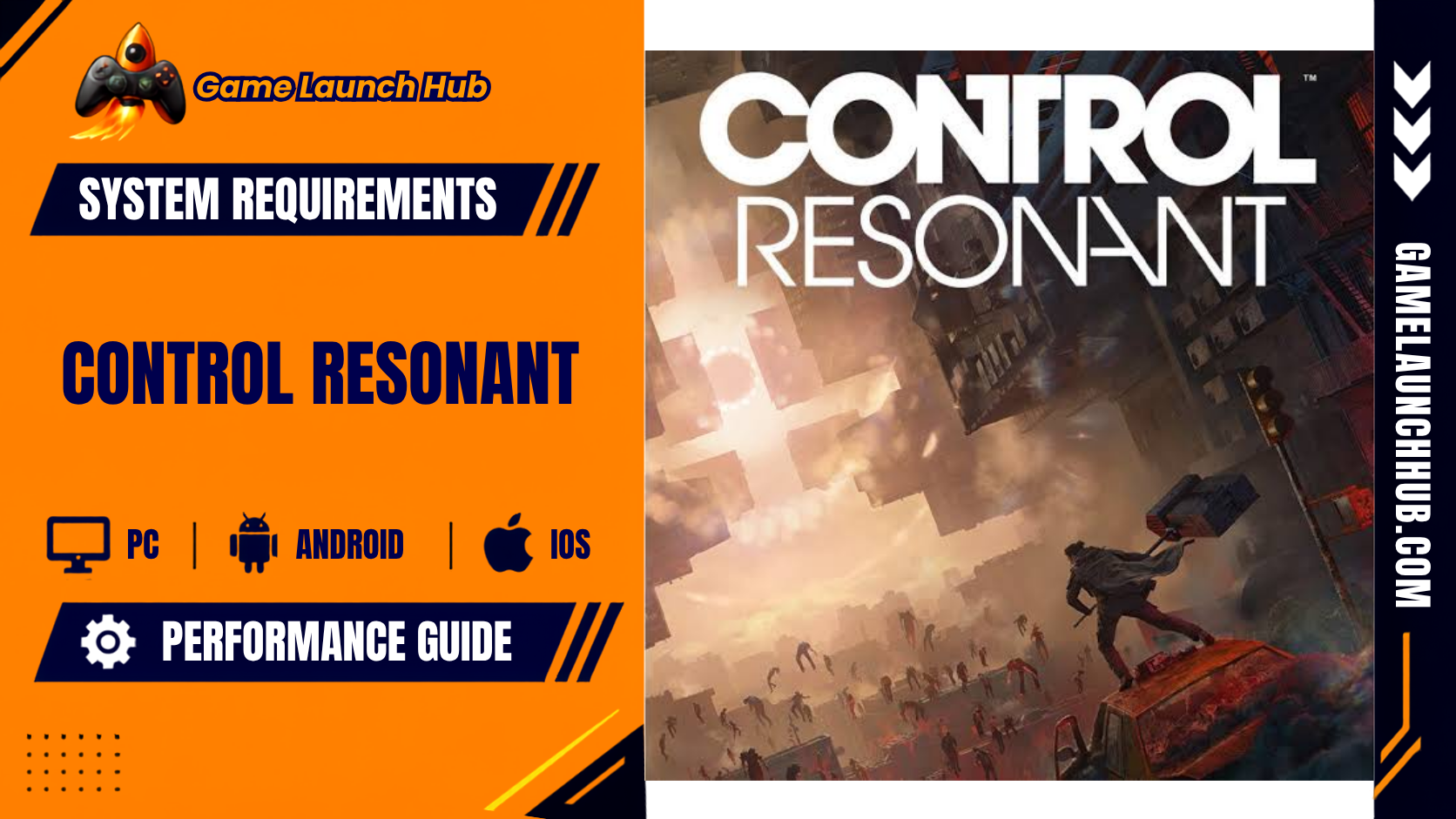
Control Resonant is Remedy Entertainment’s sequel to 2019’s Control, and it moves the action from the Oldest House to a warped, semi-open-world Manhattan. You play as Dylan Faden, Jesse’s brother, who spent years in Federal Bureau of Control confinement and now has to use paranatural abilities against a cosmic force that is reshaping reality itself. Performance-wise, this is a technically ambitious Northlight Engine game with a genuinely wide hardware range: the PC minimum asks for a GTX 1070 from 2016, while the path-traced 4K “Enthusiast” preset requires an RTX 5080. The game launched on 24 September 2026 for PC via Steam and the Epic Games Store, PS5, and Xbox Series X|S, with Mac and GeForce NOW versions following later. The official PC specifications were published by Remedy Entertainment and detailed in IGN’s specification breakdown.
System Requirements
Minimum (Windows, 1080p at 30 FPS, Low Preset)
| Component | Requirement |
|---|---|
| OS | Windows 10 or Windows 11 (64-bit) |
| Processor | Intel Core i5-8500 or AMD Ryzen 5 3500 |
| Memory (RAM) | 16 GB |
| Graphics | NVIDIA GeForce GTX 1070 (8 GB), AMD Radeon RX 5600 XT (6 GB), or Intel Arc A580 (8 GB) |
| VRAM | 6 GB |
| DirectX | Version 12 |
| Storage | 120 GB available space on SSD (SSD required) |
| Additional Notes | Targets 1080p at 30 FPS on Low preset, Upscaler Quality, Ray Tracing Off. DLSS 4.5, FSR 4.1, and frame generation supported. Uncapped frame rate, HDR, and ultrawide support. |
Source: IGN’s PC specifications breakdown, TechPowerUp, and Guru3D. Last verified: 24 September 2026.
What this means in practice: The minimum tier targets 1080p at 30 fps on Low settings with ray tracing off, and the GTX 1070 is a 2016 upper-mid-range card. The 6 GB VRAM floor is the detail that matters most: the GTX 1070 ships with 8 GB, the RX 5600 XT with 6 GB, and the Arc A580 with 8 GB. A 4 GB card will not meet this specification. The 16 GB system RAM requirement is non-negotiable and appears at every tier, which is notable because most games list 8 GB as a minimum. The 120 GB SSD requirement has no HDD fallback, which is standard for current-generation titles but worth emphasising for a game of this size. Remedy has confirmed that ray tracing is disabled at this tier, and you will be relying on the Quality upscaler preset to hit 30 fps. If you have a gaming PC from the last six to seven years with a 6 GB GPU and 16 GB of RAM, you will clear this bar, but you are at the bottom of the visual ladder.
Recommended (Windows, 1440p at 60 FPS, Medium Preset)
| Component | Requirement |
|---|---|
| OS | Windows 10 or Windows 11 (64-bit) |
| Processor | Intel Core i7-10700 or AMD Ryzen 7 3700X |
| Memory (RAM) | 16 GB |
| Graphics | NVIDIA GeForce RTX 3060 Ti (8 GB), AMD Radeon RX 6700 XT (12 GB), or Intel Arc B580 (12 GB) |
| VRAM | 8 GB |
| DirectX | Version 12 |
| Storage | 120 GB available space on SSD (SSD required) |
| Additional Notes | Targets 1440p at 60 FPS on Medium preset, Upscaler Balanced, Ray Tracing Off. |
Source: IGN’s PC specifications breakdown, TechPowerUp, and Guru3D. Last verified: 24 September 2026.
What this means in practice: The recommended tier targets 1440p at 60 fps on Medium settings with ray tracing off. The RTX 3060 Ti is a 2020 upper-mid-range card, and the i7-10700 is a 2020 processor. The jump from 6 GB to 8 GB of VRAM is the most meaningful change between tiers, and it reflects the increased texture and geometry data that 1440p rendering demands. The 16 GB RAM requirement is identical to the minimum, which confirms the game’s memory footprint does not scale with graphical settings. The Upscaler Preset changes from Quality to Balanced, meaning the game is rendering at a lower internal resolution relative to output. If you have a gaming PC from the last four to five years with an RTX 3060 Ti or better and 16 GB of RAM, you will meet this tier comfortably. Note that ray tracing is still off at this tier, and enabling it will significantly reduce your frame rate.
Enthusiast (Windows, 4K at 60 FPS, High Preset, No Ray Tracing)
| Component | Requirement |
|---|---|
| OS | Windows 10 or Windows 11 (64-bit) |
| Processor | Intel Core i7-10700 or AMD Ryzen 7 3700X |
| Memory (RAM) | 16 GB |
| Graphics | NVIDIA GeForce RTX 3080 (10 GB) or AMD Radeon RX 6800 XT (16 GB) |
| VRAM | 10 GB |
| DirectX | Version 12 |
| Storage | 120 GB available space on SSD (SSD required) |
| Additional Notes | Targets 2160p at 60 FPS on High preset, Upscaler Performance, Ray Tracing Off. |
Source: IGN’s PC specifications breakdown, TechPowerUp, and Guru3D. Last verified: 24 September 2026.
What this means in practice: The Enthusiast tier targets 4K at 60 fps on High settings with ray tracing off, and the RTX 3080 is a 2020 flagship card. The 10 GB VRAM requirement on the RTX 3080 is the practical target for 4K rendering, and the RX 6800 XT’s 16 GB is far more than the game needs at this resolution. The Upscaler Preset is Performance, meaning the game is rendering at a significantly lower internal resolution than the 4K output. If you have a high-end gaming PC from the last three to four years with an RTX 3080-class GPU and 16 GB of RAM, you will meet this tier. However, if you want to enable ray tracing at 4K, you will need to step up to the path-traced Enthusiast preset, which requires an RTX 5080.
Enthusiast Path Tracing (Windows, 4K, Path Tracing On)
| Component | Requirement |
|---|---|
| OS | Windows 10 or Windows 11 (64-bit) |
| Processor | Intel Core i7-10700 or AMD Ryzen 7 3700X |
| Memory (RAM) | 16 GB |
| Graphics | NVIDIA GeForce RTX 5080 (16 GB) |
| VRAM | 16 GB |
| DirectX | Version 12 |
| Storage | 120 GB available space on SSD (SSD required) |
| Additional Notes | Path tracing supported at 4K on NVIDIA only. AMD graphics cards are not supported for this preset. DLSS 4.5 Ray Reconstruction available. |
Source: IGN’s PC specifications breakdown, TechPowerUp, and Guru3D. Last verified: 24 September 2026.
What this means in practice: This is the highest specification tier Remedy has published, and it is NVIDIA-only. The RTX 5080 is required for path tracing at 4K, and AMD graphics cards are not supported for this preset at all. The 16 GB VRAM requirement is the highest of any tier, and it reflects the memory demands of path-traced lighting, reflections, and global illumination at 4K resolution. If you own an AMD GPU and want to experience path tracing in Control Resonant, you cannot. This is a notable limitation, particularly given that AMD’s RX 7900 XTX also ships with 24 GB of VRAM. The DLSS 4.5 Ray Reconstruction feature is available on compatible NVIDIA hardware, which improves the quality of ray-traced effects.
PC Performance Reality: Read Before Buying
The official specifications tell an optimistic story, but independent testing paints a more demanding picture. TechPowerUp’s benchmarking found that even an RTX 5090 drops to 48 fps at native 4K with ray tracing and no upscaling, with the RTX 5080 falling below 30 fps under the same conditions. TweakTown confirmed these results, noting that “even the RTX 5090 can’t hit 60FPS in Control Resonant without upscaling.” When path tracing is enabled at 4K, the RTX 5090 drops from an average of 72 fps to 39 fps, a roughly 50 percent performance loss. DLSS 5 generative neural rendering, when enabled on the RTX 5090, reduces frame rate to 30 fps at 4K according to GameGPU’s testing.
The practical takeaway is this: the published specifications assume upscaling is enabled at all tiers, and the frame rate targets are only achievable with DLSS, FSR, or XeSS active. If you want to run the game at native resolution, you will need significantly more GPU horsepower than the specification sheet suggests. Yahoo Tech’s PC performance analysis found that the game “looks grand at lower settings,” so feel free to crank them down for better performance without losing the game’s visual identity.
A Note on VRAM and System RAM
The 6 GB VRAM minimum and 16 GB system RAM requirement tell a consistent story. This is a Northlight Engine game, and Remedy’s engine has historically been VRAM-hungry due to its high-resolution texture pipeline and real-time lighting systems. The 8 GB VRAM on the recommended tier is the practical target for 1440p, and the 10 GB to 16 GB on the Enthusiast tiers reflects the demands of 4K and path tracing. The 16 GB system RAM requirement is non-negotiable and appears at every single tier, which means the game’s memory footprint is fixed regardless of settings. If you are running 8 GB of system RAM, you cannot run Control Resonant. Do not upgrade your GPU without also ensuring you have 16 GB of RAM.
PlayStation 5 and PS5 Pro
| Component | Requirement |
|---|---|
| Firmware | Latest PS5 system software |
| Storage | Not specified on the PlayStation Store listing; PC version requires 120 GB |
| Performance (PS5) | Performance: 864p internal, reconstructed to 1440p via FSR, 60 fps target. Quality: 1260p internal, 30 fps, no ray tracing. |
| Performance (PS5 Pro) | Performance: 864p reconstructed to 4K via PSSR, 60 fps. Quality: 1224p with hardware ray tracing, 30 fps. Balanced: 1080p with ray tracing, 40 fps. |
| Additional Notes | Digital Deluxe Edition owners on PS5 receive 48 hours of early access. DualSense adaptive triggers and haptic feedback supported. |
Source: IXBT Games, Multiplayer.it’s Digital Foundry analysis, and Eurogamer Germany. Last verified: 24 September 2026.
What this means in practice: The base PS5 offers two modes. Performance mode runs at 864p internally, reconstructed to 1440p via FSR, targeting 60 fps, and Digital Foundry describes the target as “generally stable.” Quality mode pushes to 1260p internally at 30 fps, but crucially does not include ray tracing. The PS5 Pro is the definitive console version. Its Performance mode reconstructs from 864p to 4K using PSSR, which significantly reduces aliasing and shimmering. Its Quality and Balanced modes add hardware ray tracing for reflections and shadows, with Quality running at 1224p/30 fps and Balanced at 1080p/40 fps. Digital Foundry notes that “the PS5 Pro represents the most evident leap,” and describes it as “the console platform that offers the most complete visual experience.” If you own a PS5 Pro, this is the best way to play Control Resonant on console.
Xbox Series X|S
| Component | Requirement |
|---|---|
| Firmware | Latest Xbox system software |
| Storage | Not specified on the Xbox Store listing; PC version requires 120 GB |
| Performance (Series X) | Performance: 864p internal, reconstructed to 1440p via FSR, 60 fps target. Quality: 1260p internal, 30 fps, no ray tracing. |
| Performance (Series S) | Single mode: 864p at 30 fps, no ray tracing, no advanced options. |
| Additional Notes | Xbox Play Anywhere supported. Cross-progression between Xbox and Windows PC. |
Source: IXBT Games, Multiplayer.it’s Digital Foundry analysis, and Multiplayer.it’s Xbox Play Anywhere coverage. Last verified: 24 September 2026.
What this means in practice: The Xbox Series X mirrors the base PS5 exactly: Performance mode at 864p internal reconstructed to 1440p via FSR at 60 fps, and Quality mode at 1260p at 30 fps without ray tracing. Digital Foundry’s testing found “very similar results” between the two platforms. The Xbox Series S is the weakest console version, running at a single 864p/30 fps mode with no ray tracing and no advanced options. Digital Foundry describes it as “stable but lacking the advanced options” available on other platforms. The Xbox Play Anywhere support is a genuine value point: a single digital purchase grants access on both Xbox Series X|S and Windows PC, with cross-progression between them. Remedy’s senior communications manager Miika Huttunen stated: “We want players to feel at home with Control Resonant, wherever they choose to play”.
Nintendo Switch 2: Not Available
Control Resonant has no Nintendo Switch 2 version. Remedy has confirmed the game for PC, PS5, and Xbox Series X|S only, with Mac and GeForce NOW versions following later in 2026. While Remedy has stated it is optimising for handheld PCs and Huttunen noted that “this work on handheld optimisation could even favour the creation of a future Nintendo Switch 2 conversion,” there is no confirmed Switch 2 version and no official announcement. If you play primarily on Nintendo hardware, you cannot access Control Resonant at this time.
Steam Deck and Handheld PCs
| Component | Requirement |
|---|---|
| Compatibility | Playable but rough. Remedy confirmed Steam Deck support at launch, but independent testing found performance “rough” even after the first patch. |
| Performance | Cannot hold 30 fps even on the lowest preset with Ultra Performance upscaling. Hitching and freezing during traversal in open areas of Manhattan. One analysis measured an average of 11 fps on Steam Deck, with drops to 8 fps. |
| Additional Notes | Handheld preset included in graphics options. Supports 16:10 and HDR. FSR 4 and DLSS supported. DualSense adaptive triggers listed in PC options. |
Source: RPG Site’s Steam Deck impressions, Noticias3D, and Multiplayer.it’s handheld optimisation coverage. Last verified: 24 September 2026.
What this means in practice: Control Resonant is playable on Steam Deck, but it is not a good experience. Remedy confirmed Steam Deck support at launch and invested time in handheld optimisation, but RPG Site’s testing found that the game “can’t hold 30fps even on the lowest preset and with Ultra Performance upscaling”, with hitching and freezing during traversal in the open portions of Manhattan. One analysis measured an average of 11 fps on Steam Deck, with drops to 8 fps, and noted that “no matter how low we configure the game, the Steam Deck cannot maintain a stable 30 fps”. On the ROG Ally Z1 Extreme, performance is better, reaching 40 to 50 fps in some scenes, but still drops below 30 fps during open-area traversal and combat. RPG Site’s verdict is that the game is “still rough, but there’s potential,” and “a few patches away from being decent on Steam Deck.” If you own a Steam Deck and want to play Control Resonant, this is not a recommended experience at launch. The ROG Ally X is a better handheld option, but even there the experience is compromised.
macOS and GeForce NOW: Coming Later
Control Resonant is confirmed for Mac via Steam and the App Store later in 2026, according to Remedy’s official announcement. The game will also launch with GeForce NOW support. If you are a Mac user, you will need to wait for the Mac version to release, or play via GeForce NOW if you have a subscription.
Price and Editions
Control Resonant is available in Standard and Digital Deluxe editions. Digital Deluxe owners on PS5 receive 48 hours of early access, according to IXBT Games. The game supports uncapped frame rate, HDR, and ultrawide displays on PC, and includes DLSS 4.5, FSR 4.1, frame generation, and DLSS 4.5 Ray Reconstruction for compatible hardware.
Final Verdict: Can Your Setup Run Control Resonant?
Control Resonant is a technically ambitious game with a genuinely wide hardware range, but the specifications come with an important caveat: every frame rate target assumes upscaling is enabled. The minimum spec asks for a GTX 1070, 16 GB of RAM, and a 120 GB SSD, which is hardware from 2016. The 6 GB VRAM floor is the hard threshold: a 4 GB card will not meet it. The 16 GB RAM requirement is non-negotiable at every tier, so if you are running 8 GB, you cannot play this game regardless of your GPU. The 120 GB SSD requirement has no HDD fallback.
The recommended tier asks for an RTX 3060 Ti and 16 GB of RAM for 1440p at 60 fps on Medium settings with ray tracing off. If you have a gaming PC from the last four to five years with an 8 GB GPU and 16 GB of RAM, you will meet this tier. The Enthusiast tier asks for an RTX 3080 for 4K at 60 fps on High settings without ray tracing, and the path-traced Enthusiast tier requires an RTX 5080 and is NVIDIA-only.
The performance reality is more demanding than the spec sheet suggests. TechPowerUp found that even an RTX 5090 drops to 48 fps at native 4K with ray tracing and no upscaling, and the RTX 5080 falls below 30 fps under the same conditions. If you want to run the game at native resolution with ray tracing, you will need hardware significantly above the published specifications. Upscaling is not optional for hitting the stated frame rate targets.
On console, the PS5 Pro is the definitive version, with PSSR reconstruction to 4K in Performance mode and hardware ray tracing in Quality and Balanced modes. The base PS5 and Xbox Series X are broadly comparable, with 864p internal resolution reconstructed to 1440p at 60 fps in Performance mode. The Xbox Series S is the weakest console version, capped at 864p/30 fps with no ray tracing. There is no Nintendo Switch 2 version. On Steam Deck, the game is playable but rough, and not recommended at launch.
Specs and performance may be revised by Remedy Entertainment in future patches, and the developer has already released a first patch improving Steam Deck performance. This article reflects the official Remedy Entertainment PC specifications, IGN’s hardware breakdown, TechPowerUp, Guru3D, Digital Foundry’s console analysis via Multiplayer.it, IXBT Games, RPG Site’s Steam Deck testing, TweakTown, GameGPU, and verified outlet reports as of 24 September 2026. Chen Xi verifies all specifications by checking official store pages and dating each table; no numbers in this article are estimated or inferred.